
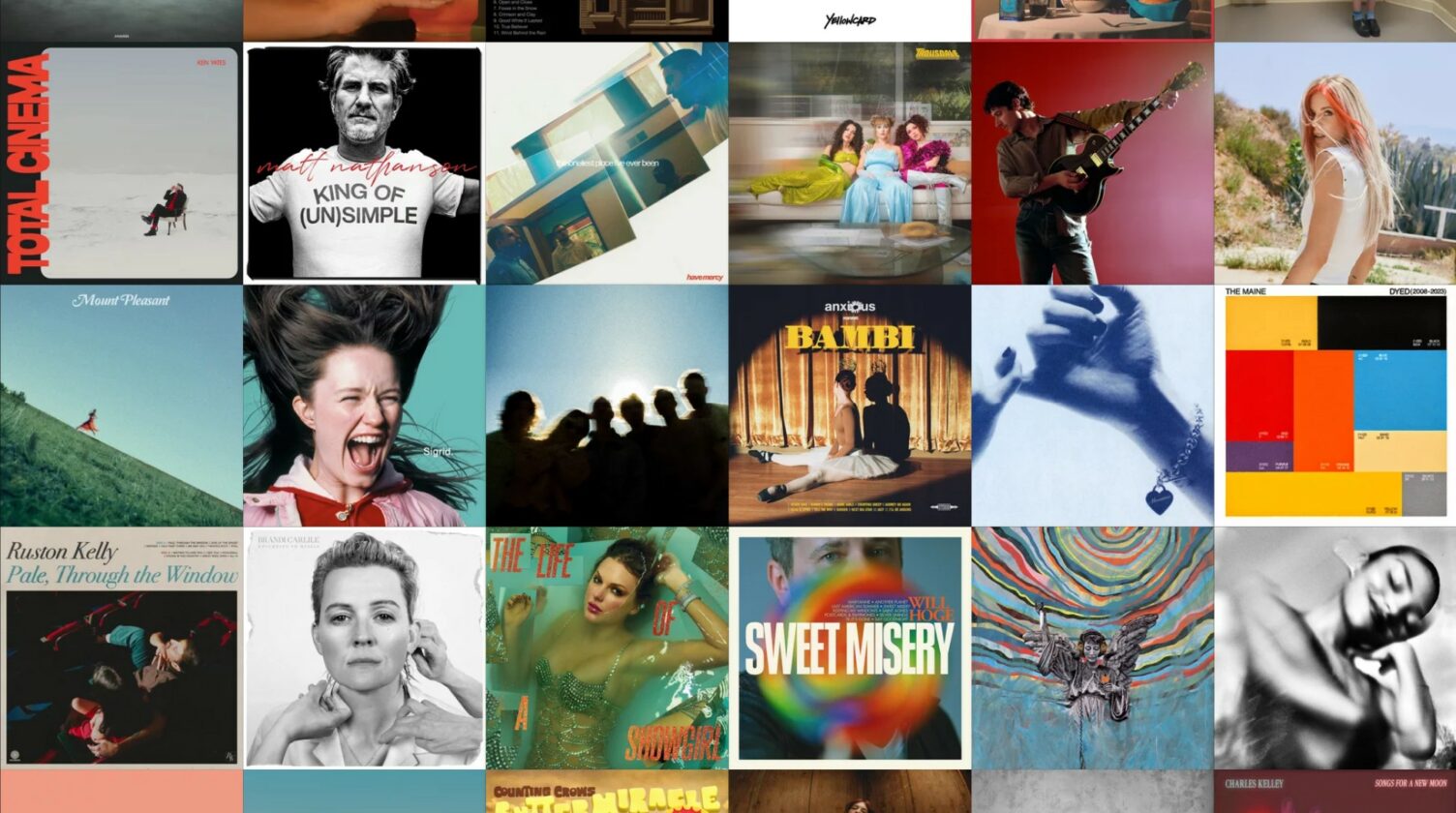
I spent a huge amount of time and emotional energy in 2025 going back through the back pages of my own music listening history. The My Life In 35 Songs series, which I launched in March and wrapped on my 35th birthday in November, provided space on this website every week for me to gush about the music that shaped who I am. It was a massive commitment, and it left little time for any other type of music writing. But it also served as a stirring reminder of how important a good song or a great album can be. For those of us on this website, music doesn’t stop being formative or emotionally resonant just because we got beyond those teenage years of self-discovery and first-time experiences. On the contrary, if you give yourself over to it, music can continue to be a true companion for your entire life.
With that thought in mind, I dove into compiling my best-of-the-year list for 2025 with as much enthusiasm and excitement as I’ve ever brought to a year-end list before. My Life In 35 Songs felt freeing and invigorating because the structure of it gave me permission to be 100 percent honest – not only about the music I’ve loved, but also about life experiences that had previously felt too raw or too private to share. I wanted to bring that energy to this list – to try to tune out any kind of popular consensus and zero in on the albums that felt vital to me. The resulting list has a bunch of albums you’ll surely recognize, but also a few I haven’t seen on a single other list so far. Just like My Life In 35 Songs, it feels true to who I am and to the life I lived this year.
That life was as confounding as ever in 2025 – a year that saw America go fascist, that saw seemingly every industry embrace the scourge of generative AI, and that saw me bristling against a growing number of indicators that I am simply not that young anymore. Along the way, though, I found a lot of records that did make me feel young again, or that gave me hope and light amidst the growing darkness. Here are a few dozen of them.
00. Bruce Springsteen – Tracks II: The Lost Albums
It seems insane to even ask the question, but was this the best year ever to be a Bruce Springsteen fan? And yeah, I know it’s been decades since Bruce made most of his iconic albums, or since he and the E Street Band were at their peaks as live performers. There are any number of years that would be more obvious “best year ever” candidates for The Boss, be it 1975, or 1978, or 1984. But the fact that I’m even able to pose the question with a straight face says a hell of a lot, and I’m able to do that because Bruce decided 2025 was the right time to start emptying the vaults.
This year, us Bruce fans got not one but two long-wishlisted releases: a reissue of 1982’s Nebraska, including the fabled Electric Nebraska album; and Tracks II, the sequel to Springsteen’s 66-song b-side collection from 1998. Both are exceptional, but Tracks II: The Lost Albums ought to go down in history as one of the most miraculous archival releases in popular music history. A juggernaut box set featuring 320 minutes of music – most of it completely unheard – Tracks II would be hugely noteworthy even if it were merely cataloged as a data dump of individual songs. Springsteen did just that before, with the first Tracks collection, and many fans still hold that box up as some of his very best music. But Tracks II is, for my money, even more impressive, and a lot of that has to do with the presentation. Tracks mostly collected the songs that Springsteen opted not to include on his run of classic albums in the 1970s and ’80s, when he was at his most prolific and had a clear Midas touch going on. Those songs deepened one’s appreciation for Bruce’s songwriting abilities, productivity, and knack for smart self-editing, but I have never felt like they dramatically changed my perception of who he was as an artist during the first two decades of his major label career.
Tracks II is a different animal, with the largest portion of the set shining a new light on what The Boss was up to in the 1990s. Long known as Bruce’s most fallow period, those years produced just three albums in real time – Human Touch, Lucky Town, and The Ghost of Tom Joad – none of which are considered classics. The popular narrative is that Springsteen spiraled after Born in the USA, broke up the E-Street Band, and then wandered in the wilderness for 15 years until a band reunion and the tragedy of September 11, 2001 shook him out of his stupor and birthed 2002’s comeback LP The Rising. Tracks II challenges that narrative by including three albums recorded and shelved in the 1990s: Streets of Philadelphia Sessions, recorded in 1993 and 1994; Somewhere North of Nashville, recorded in 1995, and Inyo, which Springsteen made while touring Tom Joad between 1995 and 1997. Of those three, only Inyo sounds similar to an existing Bruce album, playing as a mariachi-inflected sister to Tom Joad’s stark story songs. The other two achieve major revelations – Philadelphia by further pursuing the drum-machine-driven, hip-hop-influenced sound that won Springsteen his Oscar with “Streets of Philadelphia”; Somewhere North of Nashville by being a rip-roaring, barnstorming country-rock album. Together, these albums completely reframe Springsteen’s wilderness era as a period of fertile creativity and songwriting growth. And they’re not just fun sonic experiments, either: Some of the songs here are immediate pantheon-level classics – see “Waiting on the End of the World” from Philadelphia, “Poor Side of Town” from Nashville, or “When I Build My Beautiful House” from Inyo.
Those three albums feel like the heart of Tracks II, but they are far from its only pleasures. L.A. Garage Sessions ‘83 is a missing step on the road between the skeletal Nebraska and the bombastic pop songs of Born in the USA, with a late-night summer dream vibe that feels like a blueprint for modern bands like The War on Drugs. Bruce recorded Faithless in the mid-2000s as the soundtrack for a “spiritual western” film that never emerged; clock “All God’s Children” for some of the wildest Springsteen vocals you’ve ever heard; and Twilight Hours is a sweeping, starry-eyed pop romance in the style of Burt Bacharach and Glen Campbell, recorded as a sister to 2019’s similarly throwback Western Stars. Of the seven albums in the box, only the last one, Perfect World, feels relatively inessential, but that’s mostly because it was compiled as an odds-and-sods album from a variety of eras and styles rather than existing as its own complete thought.
We’re in the era of the musical data dump. These days, bloated tracklists, deluxe editions that arrive three months after the original album, and easy instant access to it all on streaming services have collectively dulled the impact of a great b-side or lost album. I get the impulse, from the artist and label side, to strike while the iron is hot. But there is something so satisfying about a release like Tracks II, and about suddenly getting a whole new perspective on an artist you thought you had an extremely solid handle on. This music is so fascinating and so expansive that I still feel like I’m only scratching the surface of its offerings six months after release. So, while I know this is a lot of words to expend in service of something that is not technically even ranking on my albums-of-the-year list, Tracks II absolutely merits it. When I look back at 2025, I have a feeling it’s this release more than any one album from this year that will dominate my memories.
01. Ryan Hurd – Midwest Rock & Roll
My two favorite albums of the year were made by people who were once married to one another, both releasing their first music since they divorced and went their separate ways. Where my number 2, Maren Morris’s Dreamsicle, reckons with that fallout in real time, though, Ryan Hurd’s Midwest Rock & Roll offers something different. “This album was written and created slowly in 2023,” Hurd wrote in the liner notes. “I thought it would be released in the spring of ’24, but here we are a year later, and Midwest Rock & Roll is finally part of the universe. This album is a timestamp. I felt like it deserved to be released the way I wrote it.” Hurd probably felt inclined to add that note given that, 1) in October 2023, Morris filed for divorce, and 2) Midwest Rock & Roll is decidedly not a divorce album.
Instead, on his second LP, Hurd packs the songs with a whole lot of love and a whole lot of nostalgia. In hindsight, it’s easy to hear the shades of a straining relationship in the lyrics. That’s certainly the case in “Die for It,” a potent anthem about wedding vows and what it means to try to keep them through thick and thin; “Love is hell, love is pain, love is sunshine and rain,” Hurd sings in the torturously good bridge. But for the most part, Midwest Rock & Roll has its mind on other things, and I found those things to be deeply relatable. Hurd built a career in Nashville’s country music scene, but he’s actually a Michigan boy raised on pop-punk, emo, and classic rock – all things the two of us share. So, when Hurd sings about brutal Michigan winters (“You set your own heart on fire when you grow up where it’s cold,” he sings on the title track) and the transcendent power of Jack’s Mannequin songs (“I remember singing, ‘Dark blue, dark blue’ in the car with you,” goes a key line in “All Night Long Days”) it feels like he’s singing about my life.
There are a lot of songs like that on Midwest Rock & Roll – songs that had me doing double or triple takes because I couldn’t believe someone was singing those words in that way on a country-rock album in 2025. On the deluxe edition of the album, there’s even a song about my hometown, something that led to me interviewing and writing about Hurd for my day job this year. It’s possible there are more parallels to my own existence on this album than on any other album ever made by someone who isn’t me.
I spent the year walking back through my own musical history for the My Life In 35 Songs series, and Midwest Rock & Roll was easily the album from 2025 that most clearly approximated what that journey felt like. And fittingly, Hurd’s playlist of songs that inspired this album includes no fewer than six of the artists I wrote about for that essay series. From the sounds of it, we had extremely similar coming-of-age experiences – which is probably why no song this year stopped my heart quite like “Youth,” an achingly raw heartbreaker about first love and how it’s wasted on kids who are too dumb not to let it slip right through their fingers. “Youth” might not even be the saddest song on the album, either: that title might belong to “Go to Bed Sober,” an utterly downtrodden breakup ballad with Sasha Alex Sloan; or “Funerals,” about how watching people you love die never gets easier, just more frequent. Or maybe it’s “The Last Song I’ll Ever Write,” the album’s defiant closer, which feels like it’s one final love song for Morris – unless it’s about the son the two share together.
As you get older, it becomes harder to find those albums that make you feel like you’re on fire. When you’re a teenager, you find them all the time, because you’re going through so many formative, emotionally intense experiences in such short order, and you’ve heard so few albums yet that it’s simply more likely you’ll stumble upon that remarkable “I can’t believe this songwriter knows that thing about my life” reaction. But I got that feeling so strongly again with Midwest Rock & Roll that listening to it was like taking a time machine back to my own youth. I can’t guarantee that people without those connection points will feel anywhere near as strongly about this album as I do. But man, when you find something that gets your heart racing like this album did for me, you’ve got to hold onto it like oxygen – lest you lose it like the young lovers in “Youth.” “I wish we bottled it up so we could feel it again,” Hurd sings on that song; with this album, he did just that.
02. Maren Morris – Dreamsicle
What do you get when you pair the seasoned songwriting gifts of one of country music’s most gifted stars with the boundless possibilities of pop music? You get Dreamsicle, an album so sharp and smart and witty that you might almost overlook how frequently gut-wrenching it is. Ostensibly a Nashville insider for years, Maren Morris always had a lot more pop in her DNA than most of her genre cohort – see jams from her 2016 major label debut Hero like the propulsive “80s Mercedes” or the sassy, sarcastic “Rich.” But after a highly publicized social media clash with Justin Aldean and his wife a few years back (over that pair’s shitty transphobic views), Morris effectively said “peace out” to Nashville. Dreamsicle is her first album since then, and – probably not coincidentally – her best. You can still hear the country in Morris’s songwriting, and definitely in her voice, but gone are all the obligatory genre tropes and hat-tips that dotted her previous albums. In their place, Morris spreads out as a writer, as a vocalist, and as a storyteller. Get a load of the lush ‘80s textures she tries on with songs like “Cry in the Car,” an out-and-out banger which wouldn’t have been out of place on that first Chappell Roan album; or “Cut!”, a duet with Julia Michaels that has an F-bomb so good it got its own t-shirt. Get a load of her latent Sheryl Crow influence – always evident on previous albums, but tucked away behind pop-country sheen – as it grabs center-stage on give-no-shits jams like “Lemonade” and “People Still Show Up.” Get a load of the sexual frankness of songs like “Push Me Over,” a sweaty, sultry slow jam she made with the band MUNA about coming out as bi; or “Bed No Breakfast,” a cute little ditty about kicking a guy or gal out of your house the morning after a one-night-stand.
Any one of these songs would be worth building an entire album around for a lesser artist. On Dreamsicle, they’re not even in contention for “best song on the album.” That title might belong to the title track, an absolutely wrenching number about struggling to stay present in the best moments of your life (“I cry that things are over while the party’s still going/I press petals between pages, when the flowers were still growing,” goes the second verse – lyrics I find deeply and troublingly relatable). It could also fairly be handed to “This Is How a Woman Leaves,” an almost shockingly raw ballad about Morris’s divorce from ex-husband Ryan Hurd (see above).
For me, though, the best song here (and the best song of the year, period) is “Holy Smoke,” the album’s shiver-inducing closing track about losing faith in religious institutions – or, at least, in the people who shout about their ties with those institutions the loudest. “There’s beauty in the essence, but somewhere along the way/The fundamental lessons get rewritten day to day/I know that I don’t know things I won’t know until I greet the grave/But tell me, can you say the same?” Morris sings in the knockout second verse. Hearing those questions in a pop song produced by Jack Antonoff would feel radical coming from almost anyone else – including Antonoff’s many more famous collaborators – but coming at the end of an album as diverse, honest, unflinching, and explosive as Dreamsicle, it simply feels like a remarkably well-earned denouement. If Morris is going to make albums this good now that she’s out in the pop sphere, I hope she never goes back to Nashville.
03. Jason Isbell – Foxes in the Snow
Albums like Foxes in the Snow – bare acoustic efforts from artists known for full-band work – tend to garner automatic comparisons to Bruce Springsteen’s Nebraska, and that probably counts for double in a year where the Boss both reissued that 1982 masterpiece and gave his blessing to a movie biopic that told the story of its creation. On Jason Isbell’s latest LP, though, the acclaimed singer-songwriter is hardly approximating the rich, socially-conscious character studies that characterized Springsteen’s darkest album. Instead, Foxes in the Snow is effectively a confessional emo record – a post-relationship bloodletting in the tradition of Dashboard Confessional’s Swiss Army Romance, or City & Colour’s Sometimes. Isbell wrote the songs in the wake of his divorce from longtime personal and creative partner Amanda Shires, and he opted to record them without his band, The 400 Unit, mostly because Shires had been a member of that band not so long ago. Rather than put his sidemen in the position of having to play on something that doesn’t always portray their friend and former colleague in a positive light, Isbell grabbed the acoustic and locked himself in a room alone.
The result is almost uncomfortably candid. “I was a gravelweed and I needed you to raise me/I’m sorry the day came when I felt that I was raised,” he sings on “Gravelweed,” referencing Amanda’s role in rescuing him from alcoholism, and hinting at the imbalance it left behind in their relationship even after he’d gotten clean. “True Believer” is even blunter: “I can’t remember my dreams, I guess it could be the meds/But the sound of you screaming won’t get out of my head,” he sings, before confessing that, even after everything, he’ll “always be a true believer” in whatever they had together.
Foxes in the Snow was easily Isbell’s least acclaimed and least talked about album since he broke through to a new audience on 2013’s Southeastern, and I can understand why. As breakup albums go, it is stark, unsparing, and sometimes a little bit mean. “All your girlfriends say I broke your fucking heart/And I don’t like it,” goes the chorus of “True Believer.” On “Eileen,” it’s “You thought the truth was just a rumor/But that’s just your way.” And on “Gravelweed,” the punchline is “I’m sorry the love songs all mean different things today.” I’ve often said that “Cover Me Up,” the opening track from Southeastern and arguably Isbell’s most famous song, is one of the greatest love songs of all time, and it’s hard, in a way, to hear him writing breakup songs about the same person who inspired it. But as someone who felt Isbell was hiding behind his story songs a bit on 2022’s (largely wonderful) Weathervanes, it’s refreshing and so emotionally cathartic to hear him be brutally honest again, and to write about himself rather than characters.
Though the breakup songs here are heavy and harsh and hard-hitting, perhaps the most impactful songs on the album capture the spirit of resilience, and of trying to carry on. “The last time I tried this sober, I was seventeen,” Isbell sings on “Good While It Lasted,” a song about the first tentative steps you take into dating after the end of a relationship that was supposed to last forever. And then there’s “Wind Behind the Rain,” the album’s final track, and a song Isbell wrote for his brother and sister-in-law for their wedding day. “I love you like the morning loves the afternoon,” he sings in the chorus. “If you leave me now, I’ll just come running after you.” Asked about the song in an interview, Isbell said he wanted to leave the album on a hopeful note: “I want people to understand that I believe there’s still always a reason to commit to something. Whether it’s a person or a belief or a way of life. The process of committing yourself is so much more valuable than how it turns out.”
04. Yellowcard – Better Days
Bands break up and get back together all the time these days, to the point where most have stopped calling it “breaking up” and started calling it “going on hiatus.” But I really, truly thought Yellowcard were done after their 2016 self-titled album. This band had already cheated death once, after their late-2000s hiatus gave way to a fruitful second wind in the 2010s, and everything about Yellowcard felt tailored to be a goodbye. Even when Yellowcard came back to mount a tour two years ago, I figured it would be a one-off – and the same went for Childhood Eyes, a solid EP from 2023 that also sounds a little bit like a band shaking off the rust. But there’s nothing rusty about Better Days, and there’s nothing about it that feels like a tentative one-off either. On their first full-length album in nine years, Yellowcard sound completely and utterly reinvigorated. Maybe a global pandemic made the guys realize how much they loved music and one another. Maybe having some new blood in the mix – mostly thanks to Blink-182’s Travis Barker, who produces and plays drums – helped recalibrate the machine in an effective way. Maybe my own nostalgia is doing a whole lot of work here. Whatever the reason, there were few music moments this year that I found as thrilling as hearing the first two pre-release tracks – “Better Days” and “Honestly I” – for the first time and realizing I could turn my expectations up to 11. Ferocious pop-punk anthems like “Love Letters Lost” and “Skin Scraped” are maybe even better, bringing back a version of this band that we haven’t heard since before they started drifting toward more experimental textures on 2014’s Lift a Sail. Best of all is “Bedroom Posters,” a song that captures how it feels to hear this band playing songs like it’s 2003 all over again: “Tear down my bedroom posters/Don’t say those days are over.” If you ever need a reminder that the bands you loved when you were young can still be vital when you’re old, Yellowcard have delivered it.
05. Brian Dunne – Clams Casino
One of my core music memories is getting my first iPod for Christmas all the way back in 2004. My brother unwrapped the same model that morning, and we both spent the holiday ripping every CD in our collections to our respective computers, racing to amass an mp3 arsenal worthy of this new 20-gigabyte device. In the days and weeks that followed, once I’d run through every CD that I owned or my brother owned, I turned my attention to my parents’ collection, digging through stacks of old CDs to find any names I even kind of recognized. It was a fun exercise in music discovery, and clued me into everything from Bruce Springsteen to Billy Joel to Tom Petty to John Mellencamp. I bring that memory up now because Clams Casino, the debut album from singer-songwriter Brian Dunne, feels like the kind of album you’d find while crate-digging your parents’ CD collection, and I don’t just say that because of the retro “compact disc” icon that appears in the upper lefthand corner of the album cover. No, Clams Casino simply SOUNDS the way radio rock used to sound. Just listen to the Bryan Adams-like rasp that hitches in Dunne’s voice during the big runaway train chorus of the title track, or the way Dunne and his band pull off a chef’s kiss key change on “Rockland County.” These are sturdy, well-written pop-rock songs that, in another era, probably would have been hits. I hope I live to see a time when this kind of music recaptures the public consciousness again. Even if that doesn’t happen, though, I’m happy to have albums like Clams Casino – and to rank them very, very high on lists like this one.
06. Audrey Hobert – Who’s the Clown
There was something exciting happening on last year’s Gracie Abrams LP, The Secret of Us, and it wasn’t the duet with Taylor Swift. When Abrams broke through in 2023 with her album Good Riddance, she did so with a set of songs that sounded like Swift cosplay, circa evermore. The reason wasn’t hard to see: Abrams made that album with The National’s Aaron Dessner, and every single song on it was cowritten with him. Some of that piano-looped, whisper-sung sound carried over to The Secret of Us, but the best songs on that record – lead single “Risk,” album tracks “Blowing Smoke” and “Let It Happen,” and deluxe edition monster hit “That’s So True” – had a livewire energy and a stream-of-consciousness lyrical style that felt almost alarmingly different from where Abrams had been just a year before. If you were wondering what spurred that change, check the liner notes and you’ll see a common thread: Audrey Hobert, the 26-year-old television writer turned songwriter who helped pen all four songs. It turns out Hobert was bringing a whole lot of the wordy, nervy, insecure energy that made those Secret of Us highlights so great, because that’s also the house style of Who’s the Clown, her debut album. These songs are so full of life that you can almost see them broadcasting on a TV screen in your head. True to her roots, Hobert even writes some of the songs about TV – tracks that use shows like Sex and the City (“This isn’t Sex and the City/Nobody sees me and knows of my column/Nobody sees me at all is the problem”) and Friends (“But now I’m never lonely, not since I met Joey/But when I turn the lights off, Joey doesn’t hold me”) as clever sounding boards for Hobert’s own modern twentysomething angst. That pairing, between the cleverness and the malaise, speaks to one of the most potent and frustrating truths about young adulthood, which is the glaring mismatch between your expectations for what life should be like and what it actually turns out to be. On “Chateau,” Hobert sings about reaching the rarified air of an exclusive industry party at the famed Chateau Marmont, only to find that, well…it kind of sucks (“Can’t lie, but I’m thinking, like, high school was better than this”). Who’s the Clown serves up a lot of that – songs that can make you laugh while also eliciting an ache somewhere deep inside of you – and it does it while also being insanely catchy (see “Sue Me” or “Don’t Go Back to His Ass”). If there was a “future of pop” breakthrough artist in 2025, Audrey Hobert was it.
07. Ken Yates – Total Cinema
Last.fm statistics will never be able to do it justice, given how much of my listening these days happens on vinyl, but it’s possible that no artist has gotten more play time from me since the dawn of the 2020s than Ken Yates. Stormy summer nights; days in the winter when the sun seems to set in the mid-afternoon; long, long drives; dinner parties with friends; election night 2024, and all the awful existential dread it entailed: On all of these occasions and many more, Yates has become one of my go-to artists. Though I had never even heard of him prior to his 2020 album Quiet Talkers, he’s morphed into one of those “old friend” artists, whose music sounds comforting and thought-provoking and beautiful, pretty much regardless of the mood I’m in. Part of it is that so much of Yates’s music is soothing, from the even-keeled calm of his vocal delivery to the easy flow of his melodies. Most of the songs on Total Cinema feel so relaxing and agreeable that you might overlook the craft or profundity of the music. But then he’ll turn around and give you an expertly-crafted pop song (“Under the Cover of Light,” which splits the difference between Matt Nathanson and The War on Drugs), or a gorgeous guitar solo (the John Mayer circa Battle Studies beauty that breaks through at the end of “My Love for You Is a Straight Line”), or a grief-ridden marvel so good it will rip your heart in two (“Sometimes I still talk to you like you’re still sitting there/I’ll be setting up your table with your silverware,” Yates sings in the superb, painful “Perennials”). This type of guitar-led singer-songwriter music is often looked down upon because the artists who are best at it make it sound effortless. Such is the case with Ken Yates, and on Total Cinema, he never breaks a sweat. It makes it all the more miraculous that it’s one of those rare albums where every single note, lyric, and production choice seems to be in just the right place.
08. Matt Nathanson – King of (Un)Simple
A lot of us music fans spend years wishing our favorite artists would go back and make records that sound like the ones that made us fall in love with them. In the vast majority of cases, those wishes never come true. But Matt Nathanson’s new album, King of (Un)Simple, actually does sound a lot like Beneath These Fireworks, the 2003 major label debut that put him on the map. That album came out the year Nathanson turned 30, and the songs were perfect sad-young-man music – classics like “I Saw,” “Curve of the Earth,” and “Bent” that still make my heart feel like it just got broken for the first time. Despite the fact that King of (Un)Simple is arriving 22 years after Fireworks, there are songs here that have that same kind of magic – the magic of being young and feeling like nothing has ever been more important than that breakup song you can’t stop listening to. “I want to believe in the sound of simple chords, not the sound of slamming doors,” Matt sings on “Simple Chords,” before twisting the knife just like he used to; “But i don’t think you listen anymore.” But the real magic of King of (Un)Simple is that, every time it fools you into thinking its 2003 again, there’s another shoe waiting to drop on the very next track, or the very next verse, or the very next line. True to the album’s title, the tunes here are deceptively simple. They sound like love songs or heartbreak lullabies on the surface, but listen a little deeper and you’ll hear that there’s more to the equation – existential questions of belonging and politics and love and what it means to exist in a world on fire. “We’ll move to the moon if they won’t make room here for us,” Matt sings on one track; on another, he hands off the key verse to the Indigo Girls for a scathing indictment of the US of A: “America’s a country club at best/Safe harbor for the famous and the blessed/Captain Kirk finally made it up to space/Like there’s no one down here left for him to save/We’re over-served and unimpressed/Let’s pack it up and leave this mess/Playing Whitney Houston’s national anthem.” I’ve been a fan of Nathanson for long enough now to know he’ll never get his due for being one of the best songwriters in the world, but he’ll still always be one of my favorites.
09. Have Mercy – The Loneliest Place I’ve Ever Been
“It’s a song for anyone who has ever looked back and wished they had done more, called sooner, stayed longer, and loved louder.” Have Mercy singer Brian Swindle said those words about “August 17,” the second track on band’s new album The Loneliest Place I’ve Ever Been, and one of the many tracks on this album that hits like a punch right to the heart. It would be an exceptional song about loss in any circumstance – “I should have picked up the phone/I should have made some plans to see you/Now it’s all too late and the times were great/I’ll miss you,” goes the chorus, delivered with hair-raising intensity by Swindle. But the name of the track, and how it ties into what happened in my own life on August 17 of this year, has made the song feel extra potent for me. That day, while scrolling my Facebook feed after lunch, I saw that a friend of mine from high school, Logan, had lost his multi-year battle with cancer. The news crushed me, not just because it felt impossibly wrong knowing that someone as young and full of life as Logan had died, and not just because we’d been so close during high school, but also because I’d largely lost touch with him in recent years. Why hadn’t I picked up the phone? Why hadn’t I made more effort to spend time with him, especially after his cancer diagnosis? Why had I assumed he’d prevail in his fight against the disease? Why? Hearing “August 17” cuts right to the core of the regret and guilt and heartbreak I feel in the wake of Logan’s death, and the fact that the name of the song is the date he died is one of those eerie coincidences that makes me think music is sometimes sent to us by some higher power when we need it most. It doesn’t hurt that The Loneliest Place I’ve Ever Been sounds like the music that used to make me feel that kind of touched-by-an-angel magic most acutely. This album and its big, bruising, emotionally intense emo songs about heartbreak and resilience certainly feel molded in the tradition of something like “Believe in What You Want” from Jimmy Eat World’s 1999 masterpiece Clarity. It’s the kind of album that can make you nostalgic even though you’re hearing it for the very first time.
10. Trousdale – Growing Pains
Can someone tell Taylor Swift to put Trousdale on her “future opening acts” list? This pop trio of powerhouse female vocalists already seemed ready for the big leagues on their debut full-length, 2023’s Out of My Mind, and they solidify that polish and professionalism on the follow-up, Growing Pains. While it lacks the can’t-stop-playing-them-on-repeat earworms that hooked me on Out of My Mind – namely, that album’s opening track “Bad Blood” and its sweepingly romantic banger “Go There” – Growing Pains shows off so many different pathways to “hit song” potential that I almost can’t believe 2025 wasn’t the mainstream breakthrough year for these gals. The big hooky pop song? Check, in the form of lead single “Growing Pains,” complete with a bridge refrain that seems tailor-made for a stadium sing-along. The potential pop-country crossover? Check, in the form of “Lonely Night,” which has shades of The Chicks, or maybe The Coors’ 2000 smash “Breathless.” The more rock-leaning number? Check, in the form of “Vertigo,” a propulsive crowd-pleaser that is, fittingly, about chasing your rock ‘n’ roll dreams. The writerly ballad to win over all the Taylor Swift disciples? Check, in the form of “Warm Shoulder, Cold Heart,” which has a chorus so Swiftian I almost can’t believe Taylor didn’t write it first. These are sturdy, catchy, memorable songs that would probably work in any hands. But they’re elevated by Trousdale’s out-of-this-world three-part harmonies and the metric ton of attitude and charisma these women bring to the table. Make them stars!
11. The Berries – The Berries
In the interest of full disclosure, I should admit that I had never even heard of this band prior to December 12. But there’s always at least one late-breaker album that catches my ears thanks to the deluge of album-of-the-year lists that hits every December, and this year, that album was The Berries. When I pushed play, I knew within two minutes of the first track that I was going to have to find space for this album on my list, and I knew it because The Berries is the kind of guitar album that seemingly doesn’t get made anymore. While the record has garnered perfectly logical comparisons to the likes of Tom Petty (just look at that Damn the Torpedoes reminiscent album cover) and The War on Drugs (thanks to the hazy, half-remembered-dream feel of many of the songs), the word my brain started screaming immediately when I heard this album was “nineties.” The guitar solo on “Wind Chime” sounds like something from the middle of the 1996 Counting Crows masterpiece Recovering the Satellites. Frontman Matt Berry’s voice has shades of Jakob Dylan, and songs like the gorgeous “Run You Down” wouldn’t have been out of place on The Wallflowers breakthrough LP Bringing Down the Horse. “Something Better” is The Beatles by way of Oasis, with some of that same George Harrison-style grandeur I fell in love with on “Don’t Look Back in Anger.” “Vagabond” sounds like a Whiskeytown song, with some notes of Dizzy up the Girl era Goo Goo Dolls thrown into the recipe. I could go on and on, but the point is that these reference points are, for me, like a warm bed: endlessly luxuriant and comforting and familiar. And so, while The Berries has only been in my life for three weeks, I feel at ease saying it’s going to stay in my rotation, simply because it feels like a record that’s been in my life for three decades.
12. Taylor Acorn – Poster Child
It’s undeniable that Taylor Acorn is playing the nostalgia card. A dead-ringer for early Avril Lavigne, Acorn’s music slots more effortlessly alongside early-2000s pop-punk and emo records than most of the new albums being made by the surviving bands from that era. I’d wager that, if I were to throw songs like “Hangman” and “Poster Child” onto a playlist of songs from the When We Were Young cadre of bands, I’d be able to trick a lot of people into thinking they came out in 2004. But Acorn, who only turned 10 in 2004, clearly just loved this music while growing up, and learned a whole lot about how to structure a song from listening to the radio just as emo and pop-punk bands were getting their pop glow-up moment. As a result, she’s almost preternaturally gifted at making songs that push all your emotional buttons at the same time, in just the right ways. The gut-punch lyricism; the big, earworm choruses; the powerful, dramatic vocal delivery; the crunchy guitars produced just right for modern rock radio, circa 2000. Acorn has gone on record saying that, before she found pop-punk, she was a fan of slick radio rock bands like Matchbox Twenty and Vertical Horizon, as well as harder-edged radio darlings like Evanescence. Regardless of whether you liked all those bands in the moment, there was a craft and punch to what each of them did that yielded arguably the last gasp of rock music dominance in the mainstream. Acorn wants that moment back, and so she makes songs that grab you by the heart and the throat right away, just like “Push” and “I’m Still Here” and “My Immortal” did. Personally, I’m particularly fond of “Home Videos” (“I wish I could go back/To headphones, backseat of the car/When the worst thing you could break/Was just a window or an arm,” Acorn sings, in one of the year’s best choruses), but Acorn has more tools in her kit than nostalgia. She’s equally good at writing songs about pulse-pounding, stomach-dropping thrills of falling in love (“Theme Park”) or the sharp sting of betrayal at the hands of someone you trusted (“Blood on Your Hands”) or the simple, worn-out pain of being the person who cares more (“Cheap Dopamine”).
13. Kelsea Ballerini – Mount Pleasant
“Coming of age,” as we typically define it, refers to the period of transition from childhood to adulthood – those bittersweet moments in your late teens or early twenties when you slip the security blanket of youth and head out on your own. Listening to Kelsea Ballerini’s latest project, though, it strikes me that there is a second “coming of age” period in most of our lives. The first is characterized by a whole lot of big decisions: what to study in college, what career to pursue, whether to stay close to home or put a whole lot of distance between you and the place where you grew up. The second really only hangs on one question, but it’s a profound one: whether or not to have kids. That question, and the coming-of-age moment it signifies, is the subject of Mount Pleasant, a six-song EP Ballerini released this year to bridge the gap between her latest album, last fall’s Patterns, and her next one. Ballerini did a similar thing two years ago with Rolling Up the Welcome Mat, the cutting, confessional 2023 EP about her divorce that broke her through to a brand-new audience. On that record, the subject of children emerged as a point of contention between Ballerini and her now ex-husband Morgan Evans. “You didn’t ever wanna leave the house/I didn’t want a family,” she sang on “Blindsided.” One track later, on “Leave Me Again,” she was wishing Evans well by singing, “I hope that you get the house, and the good wife, and the kids.” Ballerini spends Mount Pleasant second-guessing that decision – not the divorce, but the kids thing. On opener “I Sit in Parks,” she spies on a family of four spending a day at the park, suddenly yearning for the life they have rather than the career she spent years pursuing. “Did I miss it? By now, is it a lucid dream? Is it my fault for chasing things a body clock doesn’t wait for?” she sings. The rest of the record dwells on similar questions – from the was-it-all-worth-it career lookback of “People Pleaser” (What does it mean climbing the ladder? Was it this dream that made me not matter?”) to the laundry list of regrets that is “The Revisionist.” Ballerini has a knack for writing fun, upbeat songs, but Mount Pleasant is forlorn and haunted, and that’s fitting, because that second coming-of-age moment is a forlorn and haunted time. How can you make a smart, well-considered decision about the most earthshaking, life-changing thing most of us will ever consider doing in this life? How can you do that when there’s a ticking clock in the background, and everyone else your age seems to be diving into the deep end without thinking twice? As someone who has decided not to have kids, even as everyone around him does, I felt every ounce of pain, frustration, and borderline madness that Ballerini packs into the 15 and a half minutes of this EP. Just like Welcome Mat, which I named my album of the year in 2023, Mount Pleasant proves that, even in short form, Ballerini can make more complete albums than most artists ever will.
14. Sigrid – There’s Always More That I Could Say
When did pop music get so boring? Maybe it’s a hangover from the pandemic, or a side effect of streaming and the background music generation it’s bred, or whisper-singers being in vogue rather than the big-voiced pop stars of yesteryear. Whatever the reason, pop has been on a cold streak for me lately, and in 2025, the stagnancy of the Billboard charts seemed to indicate that I wasn’t the only person feeling that way. Thank god, then, for Sigrid, who Went For It (capitalization intentional) to such a degree on her third album that it’s an absolute affront it hasn’t made her a global sensation. I found a lot to appreciate about this Norwegian singer-songwriter on her previous two albums – 2019’s Sucker Punch and 2022’s How to Let Go – but both felt a bit like a young artist trying on a variety of different costumes in search of the right fit. That’s not the case with There’s Always More That I Could Say, though. There is nothing tentative about this album. Instead, it’s all massive hooks, stadium-sized production, and audacious decisions – see the vocal affectations of “Kiss the Sky,” or the widescreen chorus hook on opener “I’ll Always Be Your Girl,” a song so good it actually does kiss the sky. There’s so much pop star attitude on these songs (sorry, “these FUCKING songs,” as Sigrid bellows on “Have You Heard This Song Before”) that on first listen you can’t help but wonder whether she’s masking so-so songwriting with big vocals and bigger charisma. But then a tune like “Eternal Sunshine” crashes in, and it’s clear that this artist is the real deal all the way around. The song, about wishing to erase someone from your memory after a particularly painful breakup, pays homage to the Jim Carrey/Kate Winslet classic from 2004, but the emotions don’t need a film reference to hit home. “I wanna paint you out the picture/I wanna still be friends with your brothers and sister,” Sigrid sings on the second chorus. It’s one of the best moments on a song this year, from the best pure pop album that 2025 had to offer.
15. The Head and the Heart – Aperture
I adored The Head and the Heart’s 2013 sophomore album Let’s Be Still, but then struggled to land back on the wavelength of this indie folk band on subsequent records. Let’s Be Still landed right in the middle of the folk rock revival, and exhibited songwriting and performance chops that were a good cut above genre torchbearers like The Lumineers and Mumford & Sons. Later albums felt less folky, less rustic, less traditional, and less interesting – at least for me. But this year, news that The Head and the Heart would be coming to my neck of the woods for a summer concert – and bringing along Katie Pruitt, one of my favorite singer-songwriters, as an opener – got me to reinvest in this band. I’m glad I did. The Head and the Heart put on a dynamite live show, especially on a hot summer night with an amphitheater full of people shouting along to the songs. And at the heart of that dynamite live show was Aperture, the band’s sixth studio album, and maybe their best yet. I’m a big fan of bands knowing exactly the right time to drop their albums, and Aperture’s May 9 release date was picture perfect. The first song on this album is called “After the Setting Sun,” and it’s an apt mission statement, because every other track here sounds like the kind of music you want playing on a boundless summer evening, where the glow of daylight lingers on the horizon for what seems like hours before the stars come out; where it stays warm until the wee small hours; where the campfire is howling and the drinks are flowing and the company is golden. Songs like “Time with My Sins,” “Arrow,” “Beg, Steal, Borrow,” and “Jubilee” got plenty of burn on my playlist all summer long, and then the title track was there in late August to lay the season to rest. “Time was made for running out/Don’t know why it took so long,” frontman Jonathan Russell sings in the beautiful, climactic bridge. Summer did run out, and I’ll be honest and say I haven’t listened to this album since it ended. But when I look back at the summer of 2025, I have a feeling it will always sound a whole lot like The Head and the Heart.
16. Anxious – Bambi
“The kind of album I would have absolutely just lived off back in high school. I love that there are still bands doing this.” The Chorus.fm forums tell me those two sentences encapsulated my first reaction to Bambi, the sophomore album from Connecticut emo band Anxious. 10 months later, I still feel that sentiment completely. I don’t usually go for bands with as much post-hardcore in their DNA as these guys, but Anxious make songs that are so achingly pretty – case-in-point is “Some Girls,” a big, yearning beauty that wouldn’t have been out of place on Jimmy Eat World’s Futures – that I almost forget the band’s harder-edged roots until frontman Grady Allen starts howling. Then, again, sometimes with a record like this one, you just want the guitars to pummel you in the face, and that’s exactly what happens on bruising anthems like “Bambi’s Theme” and “Tell Me Why.” 2025 seems likely to go down in music history as a “rock is back” year, thanks to uncharacteristically strong showings from bands like Geese, Wednesday, and Turnstile on year-end critics lists. If we are headed toward something like the early 2000s indie rock boom, though, I’m just hopeful it won’t be accompanied by the same snobbish dismissal of emo and pop-punk we saw back then, because bands like Anxious deserve their moment in the spotlight.
17. Momma – Welcome to My Blue Sky
There’s been no shortage of bands influenced by ‘90s alternative rock popping off in the past 5-10 years, but what most of them fail to remember, in their haste to recapture the fuzz, buzz, and scuzz of bands like Nirvana and The Smashing Pumpkins, is that those groups paired their abrasive edges with really, really catchy pop hooks. Momma, a female-fronted band from Calabasas, New York, seemed to forget that fact, too, on the band’s previous album – 2022’s stylish-but-substance-thin Household Name. But three years is a long time in the indie rock world, and it’s proven to be long enough for Momma to find their melodic muscle. These songs still have that distinct “basement in the ‘90s” feel that the tracks on Household Name had, but now, they come equipped with choruses worthy of the bands they’re cribbing all their moves from. Lead single “I Want You (Fever)” got stuck in my head more than any of this year’s big pop singles did – and became a more-than-worthy kickoff track for my annual 40-song summer mixtape – and tracks like “Bottle Blonde” and “Stay All Summer” serve up similarly sticky earworms. 20 or 30 years ago, an album like this would have earned Momma the keys to the kingdom: radio play, space in the MTV rotation, a massive budget to make an audacious, pristine-sounding follow-up packed with huge, catchy rock songs. We’re not living in that era anymore, and it’s a shame, because a band like this deserves all the resources to chase down immortality.
18. The Maine – Dyed (2008 – 2023)
To be honest, I’m not entirely sure where to slot Dyed, either in the conversation about this year or the dialogue about The Maine’s increasingly fascinating discography. Is it a b-sides collection? A writing and recording exercise built off fragments of long-unfinished songs? A full-fledged entry in their catalog? Supposedly comprised of one cast-off track from each of The Maine’s nine albums, Dyed would be forgiven for sounding like a grab bag, especially given how radical this band’s evolution — from neon pop-punk to danceable indie rock — has been. In reality, though, Dyed hangs together better than some of The Maine’s actual albums, and perhaps serves as a compelling argument that there’s always been more of a throughline to their songcraft than their substantial sonic shift would indicate. Opener “Two Flowers,” labeled as a remnant of the 2008 sessions that birthed The Maine’s bratty pop-punk debut Can’t Stop, Won’t Stop, actually sounds more like the moody, late-night melancholy of 2017’s Lovely Little Lonely. Similarly, “Don’t Light the Match,” tabbed with a 2010 date that corresponds with the band’s sole major label effort, that year’s very mainstream-coded Black & White, actually has more kinship with 2019’s You Are OK, the band’s most indie-centric record to date. It’s a confusing collection, given the seemingly contradictory nature of the dates, but none of that matters much when it comes to the actual songs, which are all catchy, sturdy tunes that further reinforce The Maine’s reputation as one of the most reliable outfits in modern music. If the dates on the songs indicate anything at all, it’s that this band is only getting better: see “Colored In Blue” and “Until the High Wears Off,” two of the stickiest rock songs I heard this year, and supposedly the two most recent compositions on this record. As The Maine gear up for album number 10 in 2026, those two tracks alone are enough to put them at the very top of my most anticipated list. Now, if only someone could convince these guys to keep their albums in print on vinyl…
19. Ruston Kelly – Pale, Through the Window
It’s easy to forget, considering his indie bona-fides and his success in making “dirt emo” stick as a self-descriptive genre tag, but Ruston Kelly came up as a behind-the-scenes country songwriter. The first thing I ever heard that he had a hand in was “Front Row Seat,” the title track from a gut-wrenching 2015 LP from Texas country outfit, theJosh Abbott Band. Between 2013 and 2018, he also landed cuts on albums from country artists like Hayes Carll, Lucie Silvas, and even Tim McGraw. His early releases, particularly his 2018 debut full-length Dying Star, steered hard into the Nashville direction, too, with Kelly proving a natural at writing the kind of crushingly sad “lonesome man done fucked up” songs on which modern American country music was built. But Kelly has wandered away from his country roots on the past few albums, pushing instead toward his dirt emo influences (see “Radio Cloud” from 2020’s Shape & Destroy, which legitimately sounds like a Blink-182 song) or ‘90s radio rock (2023’s The Weakness, which has a whole lot of Goo Goo Dolls in its DNA). Kelly’s fourth LP, titled Pale, Through the Window, is the most country album he’s made since Dying Star, and it’s my favorite one since then, too. Kelly premiered most of the material from the record during an intimate songwriters-in-the-round performance at the famed Bluebird Café in Nashville, and tracks like the lead single “Half Past Three” are exactly the type of profoundly sad country songs that first caught my ear on Dying Star. “I just want something that I can hold that doesn’t break,” he sings in that song, before adding: “And I’m going 95 for no good reason down the interstate/’Cause your dog gets sick/And your parents get old/And everything that used to stick/Well, I just can’t seem to hold on to ’em.” That song hurts to listen to, as do a few others here. But Kelly has gone on record saying that Pale, Through the Window is mostly about gratitude, and about finding things that made him feel whole again after a decade spent getting sober, getting married, and getting divorced left him feel empty inside. Those things include a new love (“All In”), a new sense of spirituality (“Still”), and a new willingness to take responsibility for past mistakes (“Twisted Root”). Like Dying Star, the resulting album feels like a complete journey, from a painful place to a healing place. It’s one of the most moving and satisfying listens of the year.
20. Brandi Carlile - Returning to Myself
At some point, Brandi Carlile went from promising singer-songwriter to top rock ‘n’ roll ambassador. Between her humanitarian work, her stewardship of Joni Mitchell’s return to performing, her 2025 team-up album with Elton John, and even her (now seemingly-defunct) Americana supergroup the Highwomen, Carlile’s extracurricular activities have become such a prominent and visible part of who she is that they’ve threatened to upstage her own music career. That happens to artists sometimes – guys like Dave Grohl, Bono, and Paul McCartney have absolutely embraced this kind of elder-statesman role, to the point where their own music has occasionally felt like an afterthought. But Carlile, who is 12 years younger than the youngest of that trio, always felt to me like someone who still had a lot left to say. Returning to Myself confirms that suspicion, and it does so by being about exactly the kind of dilemma I’m writing about here. Speaking to Apple Music’s Zane Lowe, Carlile admitted that serving as a sherpa for Joni, especially, “took up so much of my spiritual space and my mind space” that it left little energy for her own projects. Motivated in part by the re-election of Donald Trump, Carlile wrote Returning to Myself, an urgent and poignant album that is simultaneously a personal rediscovery and a taking up of arms. The social commentary songs are particularly potent: see “Church & State,” a ripping U2-inspired protest anthem, written the night of Trump’s 2024 victory; or “Human,” a song about how “every generation since recorded history believes that their generation is the one living through the end of the world,” as Carlile described it to Lowe. “I don’t need to see how it ends,” she sings on the latter; “It’s hard enough just being human.” It’s hard out there, all right, but albums as life-affirming as this one make it a little easier.
21. Taylor Swift – The Life of a Showgirl
Taylor Swift, in full oversaturation mode, should probably have sat 2025 out. After absolutely ruling the world during the 2023 and 2024 run of The Eras Tour – which itself came on the heels of her pandemic-defining 2020 albums and her monumentally successful re-recordings project – Taylor had more than earned herself a break from making music. She opted not to take one. That fact alone probably meant the knives were going to be out for her 12th album when it arrived this past October, and it didn’t help that she decided to keep her mouth shut about political matters all year long. Rather than grapple with the state of the world, Showgirl is mostly about Taylor falling in love with her new fiancé, Travis Kelce – though, she does reserve some time for settling scores with new and longtime enemies alike. In that sense, the album feels like the third in a trilogy with 2010’s Speak Now and 2017’s Reputation, both LPs that blend highly personal matters-of-the-heart songs with dagger-sharp rejoinders to people who have wronged her. The state of the world – and the state of Taylor’s bank account – make those fuck-off tracks hit a little differently than they did when she was taking aim at John Mayer or Kanye West 15 years ago. But she’s still deviously good at a takedown, whether she approaches the form with history-is-told-by-those-who-win smugness (“Father Figure”) or Mean Girls-level pettiness (“Actually Romantic”). It’s fair to feel like she’s punching down, or like her songs about opulent romance (“Elizabeth Taylor”), big dicks (“Wood”), and rich, famous friends (“Cancelled!”) are clangingly tone-deaf in the year of Donald Trump 2.0. Removed from the context of 2025, though, I think history will judge The Life of a Showgirl more favorably than it’s been received this year, in part for how it sheds the excessive personal baggage of its predecessor. 2024’s The Tortured Poets Department was simply too much – too many songs, too much lore, too much Matty Healy – and Showgirl feels fluffy, weightless, and economical in comparison. It’s been a minute since Taylor turned in a single as breezy and easy as “The Fate of Ophelia,” and the way the dark Fleetwood Mac-tinged verses of “Opalite” collide with the euphoric candy-shop pop of the chorus and bridge makes for one of her most compelling pop songs ever. The centerpiece ballads are just as good – “Eldest Daughter,” a messy, self-conscious love song that feels way more honest than any of the other tunes she’s written about Travis so far; or “Ruin the Friendship,” a hat-tip to her country roots with a storytelling twist so deft and heartbreaking it took my breath away the first time I heard it. There are clunky moments that feel more glaring due to the album’s fleet 12-song tracklist – particularly “Wi$h Li$t,” where Taylor, the most ambitious, capitalistic pop star in history, tries to claim that all she wants is a trad-wife fantasy with her white football star husband-to-be. At its best, though, Showgirl still has a whole lot of the magic I’ve loved about Taylor for 15 years.
22. Will Hoge – Sweet Misery
Will Hoge was one of my favorite artists in the world from 2009 to about 2015, but I’ve felt increasingly bored with his music over the course of his past several album cycles. Once upon a time, I would have called him this generation’s version of Bruce Springsteen, thanks to his songwriting acumen, his emotionality, his willingness to tackle thorny political topics in his work, and his livewire energy as a live performer. But in part because of Hoge’s move away from his rock roots and toward more of a country singer-songwriter vein, his albums just started to feel stale to me around the turn of the decade. Sweet Misery winds back the clock, resets the formula, and injects a whole lot of new life into Hoge’s songs, and the result is arguably the best album he’s made in 12 years. Inspired, perhaps, by Hoge’s journey back to the beginning of his career – he recently remastered and released his debut album, 2001’s Carousel, and then entirely re-recorded the follow-up, 2003’s Blackbird on a Lonely Wire – Sweet Misery ditches much of the country trappings of Hoge’s recent work for the things that made him special in the first place: power-pop melodies with a rootsy twang (think Tom Petty as a comparison point) backed by a ripping rock band and punctuated with more than a few killer guitar solos. Songs like “Mary-Ann,” “Last American Summer,” and “Say Goodnight” feel not so far from the balladic trappings of Hoge’s recent work, but they explode into the kind of big, expressive guitar anthems he used to make regularly. “Another Planet” is a shit-kicking rock song that recalls the feel of the sweat-dripping-down-the-walls live albums Hoge made in the early 2000s. And “Til It’s Gone” gives Hoge’s beautiful, emotive voice the kind of showcase it deserves. Put all these elements together and Sweet Misery becomes one of 2025’s great musical surprises – a tremendous second wind from an artist I’d mostly counted out. I’m thrilled to have it.
23. Motion City Soundtrack – The Same Old Wasted Wonderful World
Along with the new Yellowcard album, the latest from Motion City Soundtrack whipped me back in time to 2005, when I’d relish trips to the mall solely so I could pop in at FYE or Hot Topic and grab the albums at the top of my “need to hear” list. I still remember the way that CDs like Ocean Avenue, Lights & Sounds, and Commit This to Memory looked on those shelves, and just thinking about that image makes me nostalgic for the old ways of music consumption. Well, The Same Old Wasted Wonderful World actually sounds the way that image looks in my head: It sounds like freshman-year-of-high-school crushes and anxieties, like looking in my wallet and seeing I was down to my last $20, like browsing the shelves for what seemed like hours on end to make sure I made the right decision on how to spend my precious cash. With Better Days, Yellowcard understood the elements of their DNA that listeners were yearning for: the pounding drums, the big-ass choruses full of sunshine, the wistful flickers of violin. Motion City Soundtrack, who had been away for even longer (their last album, Panic Stations, arrived a decade ago) return similarly to the elements that were the bread and butter of their songwriting. This band, always excellent at walking the tightrope between punk rock aggression and sticky-sweet power pop melody, nail the combination here like they’ve never been gone – and absolutely slather it in the zippy synthesizers that were always their version of the Yellowcard violin. While The Same Old Wasted Wonderful World may sound like 2005, though, the lyrics speak to the 20 years that have elapsed since then. These songs are surprisingly existential, even while sounding like the pop-punk jams you played on your way to first-hour calculus. “Why don’t you say what you’re going through?” frontman Justin Pierre sings on “Melancholia,” a question that hits damn hard coming from a torchbearer for a genre where everyone used to say what they were going through. The questions continue on “Things Like This”: “Where did the time go?” Pierre sings; “Is it too late to start again?” Thankfully, for Motion City Soundtrack – and for a whole lot of other 2000s acts that have come back from the dead in recent years – the answer is no. It’s never too late.
24. Olivia Dean – The Art of Loving
It doesn’t happen that often anymore, in an era of stagnant pop charts and fragmented music listening. But every once in awhile, one great song can still come along and change an artist’s entire life in the blink of an eye. Olivia Dean had that kind of year, and that kind of song, in 2025. A British pop-soul songwriter, Dean snagged her breakthrough this year thanks to “Man I Need,” a song so immediate and so timeless that I’m certain it will follow her around forever. That song connects to a longstanding music industry tradition — sumptuous, swooning love songs fit for wedding slow dances or Valentine’s Day mixtapes — and there’s something heartening about seeing that something along those lines can still succeed in the dark, cynical world of 2025. There’s not an ounce of cynicism in “Man I Need.” In fact, it’s almost the exact opposite of Sabrina Carpenter’s “Manchild,” another one of the year’s defining hits, which gets a whole lot of mileage out of dragging and mocking an incompetent boyfriend. That’s par for the course on The Art of Loving, a total throwback to when love songs were earnest and vulnerable rather than sarcastic and snide. In that way, Dean feels like the next generation’s Adele, a classicist with a golden voice and sterling songs about matters of the heart. And similarly, I expect Dean will be a global superstar within a few years, simply because songs like the smooth neo-soul jam “So Easy (To Fall in Love)” or the chill coffeehouse pop ditty “Nice to Each Other” feel like the rare class of music that could achieve cross-generational, cross-genre appeal right now. If that does happen, “Man I Need” will probably go down as one of the most important singles of the decade. It deserves nothing less.
25. Bon Iver – Sable, Fable
There was a magic trick to what Justin Vernon did in the fall of 2024, when he released a four-song EP called Sable. That collection seemed to act as if the previous two Bon Iver albums – 2016’s electronic-heavy 22, A Million and 2019’s more arena-rock-leaning I,I – never existed. Instead, it wound back the clock to when Bon Iver was centered around an acoustic guitar and hushed songs of heartbreak. The result was electrifying, a back-to-basics move that most fans of the famously mercurial Vernon probably never expected. Even less expected, though, was the other side of the coin, which arrived when Vernon dropped the full-length Sable, Fable this past April. Though it begins with the four songs that made up the EP, presented in the same sequence as before, Sable, Fable is not a blown-out feature-length version of the EP’s woodsy return-to-form. Instead, the Fable half of the collection turns the wheel toward bright, hopeful, soulful pop music. My buddy Blake Morgan, who provides backing vocals on this album, described it to me as “windows-down music” – not something I ever had on my Bon Iver bingo card, but an apt descriptor nonetheless. On tracks like “Everything Is Peaceful Love,” “Day One,” “If I Could Only Wait,” and the gorgeously dusky “There’s a Rhythmn,” Vernon pens the purest pop songs of his career – and makes it sound effortless.
26. Kathleen Edwards – Billionaire
“If this feeling were a currency/I would be a billionaire,” Kathleen Edwards sings on the title track of her fifth studio album. Listen to the song in the background, and you might assume it’s about romantic love – perhaps in the parlance of a Chris Stapleton song from a few years ago: “She’s my treasure so very rare/She’s made me a millionaire,” he sang in that song. In reality, though, “Billionaire” is about a different kind of love – the love you feel for someone who has passed beyond the veil – and its yearning, aching portrayal of loss is some of the most potent energy I’ve heard on a song this year. “Grief is love that makes sense/Except for those of us still left/To figure out what to do/At night with all these thoughts of you/Your perfect skin, your smiling eyes/And I can see them in my mind/How your kindness ricocheted through everyone.” Those are the words to the bridge of this song, and Edwards sings them like she’s fighting for breath amidst tears, or like she’s windmilling her arms around, trying to grasp onto any remaining piece of the person she’s lost before it’s too late. Sometimes, listening to this album during my work day, that song would come on, and it would stop me in my tracks, forcing me just to close my eyes and revel in the exquisite pain of the words and the way Edwards sings them. Long a master of sad, sad songs, Edwards serves up another feast of moody melodic gems on this album – songs that glitter and glisten in extra special ways thanks to superb production work and guitar accompaniment from none other than Jason Isbell. Like Edwards’ twin masterpieces, 2002’s Failure and 2012’s Voyageur, it’s a perfect album for cold autumn afternoons.
27. Counting Crows – Butter Miracle
Counting Crows are simultaneously one of the bands I love most and one of the musical acts I find most frustrating. This band’s output of new material in the past two decades amounts to less than 50 songs, and that includes their 2012 covers album. They’ve been so inactive – basically since I became a die-hard music fan – that I sometimes forget that they are one of the best bands in the world. It was easy to miss that fact on the first suite of Butter Miracle songs, released four years ago as a standalone EP, and now re-released as the second half of this full-length album. Those four songs – “The Tall Grass,” “Elevator Boots,” “Angel of 14th Street,” and “Bobby and the Rat Kings” – certainly aren’t bad¸ but they feel more like freestyle jams in search of songs than actual fully fleshed-out songs. If you’ve seen Counting Crows live, you know that frontman Adam Duritz likes to launch into meandering improvisation sections in the middle of his band’s most famous songs – stuff like “Round Here” and “Rain King” – and there are even parts of “The Tall Grass” that fans will recognize from past live versions of “Round Here.” That same shaggy, freewheeling sensibility also characterized the band’s last album, 2014’s Somewhere Under Wonderland, and while it has its charms, I’ve now spent the better part of two decades wishing Duritz would lock in and write really sturdy, tight pop-rock songs again.
Apparently, Duritz found himself wishing for something similar in the buildup to this album’s release. The frontman has gone on record to say that Butter Miracle’s second suite of songs was supposed to see the light of day years ago, but he ended up going back to the drawing board after hearing the 2022 Gang of Youths masterpiece angel in realtime and realizing his songs weren’t finished yet. The five new songs here benefit mightily from that decision. “Spaceman in Tulsa” has some of the lively, block-party-ready vibes of one-time Crows singles like “Hanginaround” and “If I Could Give All My Love,” while “Virginia Through the Rain” captures the folky, road-tripping sensibility of 1999’s This Desert Life. Best of all is “Boxcars,” which has the same careering-around-a-corner energy of classic Counting Crows tracks like “Catapult” and “Hanging Tree,” complete with the kind of hook that made those songs sticky and indelible.
The earlier Butter Miracle songs are still just OK – Duritz didn’t go back to the drawing board on those – but the five new tracks are so fun, so well-constructed, and so impeccably played that they merit a place on this list all on their own. Here’s hoping those songs help break the dam for Duritz and we get a new Counting Crows album again in a year or two.
28. Florence + The Machine – Everybody Scream
I adored the second Florence + The Machine LP, 2011’s Ceremonials, for how much it leaned into frontwoman Florence Welch’s inherently witchy musical persona. Packed with pounding tribal drums, spooky choirs, and echoey production that seemed to suggest either castle or cave as the recording location, Ceremonials was a dark-as-night classic that sounded like a séance. (Sample song titles, for reference: “Only If for a Night,” “No Light, No Light,” “Seven Devils.”) I still remember how that album, released just days before Halloween that year, cast a lingering spell over my fall listening. I felt like there should be an album like this every year: an unofficial Halloween soundtrack worthy of being played at your annual All Hallows’ Eve party, but also featuring songs good enough (“Shake It Out,” “All This and Heaven Too”) to revisit all year long. Welch never quite recaptured that magic on subsequent albums, and I drifted away from her music as she dove deeper into her arena rock and Britpop bona-fides on albums like 2015’s How Big, How Bright, How Beautiful. But Everybody Scream rehashes the Ceremonials playbook like it’s a legacy sequel, from the Halloween week release date (this one dropped right on October 31) to its coven-of-witches vibe (please see the title track, which wouldn’t be out of place playing over the opening scenes of Macbeth). While the songs feel mystical to the degree of immortality, though, they’re actually vessels for profound vulnerability, unpacking – among other things – Welch’s 2023 near-death experience following massive internal bleeding from an ectopic pregnancy. The resulting album is a kaleidoscopic burst of emotions that felt awfully relatable in the dumb doldrums of 2025. Soul-deep sadness comingles with unquenchable rage, which itself bleeds into overwhelming gratitude just to be alive. It’s such a sensory overload that, by the time the album reaches its conclusion, there’s only one thing you’ll want to do: scream.
29. Ben Rector – The Richest Man in the World
Heartbreak, yearning, anger, frustration, love, lust, desire: These are a few of the emotions that often form the backbone to great albums. Contentment and gratitude are far less likely to be the driving force behind profound musical statements, simply because most songwriters don’t compose from a place of complete and utter satisfaction. On The Richest Man in the World, though, singer-songwriter Ben Rector sounds like he’s trying to make sure all the people he loves know just how much joy they’ve brought into his life, lest he miss the opportunity to tell them. The result is one of the most effusive, ecstatic albums of 2025 – an album so overflowing with thankfulness that it will probably make you want to call that friend or family member you haven’t talked to in a while so that you can let them know how much they mean to you. He pens these songs for his wife (“I wish I had known you when we werе in second grade/Draw you stupid pictures, eat lunch with you every day,” he sings on “Forever Doesn’t Quite Seem Long Enough”), his kids (“Golden Days,” about cherishing even the hardest parts of parenthood, because they’ll fly by too fast either way), and his whole circle of friends and family (the title track, about true wealth coming from relationships rather than money or fame). These themes and ideas, while profoundly true for many of us, are hard to pull off in songs without steering into schmaltz. But Rector has a talent for avoiding common pitfalls like that. His songs are spiritual without being preachy, dad-core without alienating us non-parents, and sentimental without losing a core of humor. If you need a record to make you feel really, purely good – something I definitely needed in 2025 – it’s hard to do better than this one.
30. Charles Kelley – Songs for a New Moon
I didn’t have “the guy from Lady Antebellum makes a nighttime ‘80s record” on my 2025 bingo card, but that’s exactly what Charles Kelley delivers on his second solo LP, Songs for a New Moon. I’ve been hit or miss on the now-renamed “Lady A” ever since they broke big on 2010’s “Need You Now,” but Kelley impressed me back in 2016 when he dropped his solo debut The Driver. That album was mostly standard mainstream country fare, but it included a few curveballs – namely, a stellar duet with Stevie Nicks on a cover of Tom Petty’s “Southern Accents” and an absolute knockout vocal performance on a Donovan Woods-penned stunner called “Leaving Nashville.” New Moon thrives in part because Kelley retains those particular aces up his sleeve – namely, his rich, powerful voice and his good taste for covers. Both are on display on “Here with Me,” a track from the 2012 Killers album Battle Born that Kelley wisely recognizes as a faux-80s classic. “Here with Me” ends up being something of a guiding light for Songs for a New Moon, with most of the songs on the record approximating a similar retro vibe, to great effect. It turns out that Kelley’s textbook country voice is excellent in this mode, particularly on earworm bangers like “Covering My Tracks” and “Take Back Goodbye.” At 15 tracks, the album overstays its welcome a bit, but give me a 10-song version and I’ll jam it on summer night drives from now until eternity.
The 2024 re-rank
It’s not the most movement I’ve ever seen on a one-year-later re-rank before, but 12 months of extra wisdom would yield a few notable changes to last year’s list.
- Donovan Woods – Things Were Never Good If They’re Not Good Now
- Kelsea Ballerini – Patterns
- Katie Pruitt – Mantras
- Coldplay – Moon Music
- Kacey Musgraves – Deeper Well
- Snow Patrol – The Forest Is The Path
- Pale Waves – Smitten
- MJ Lenderman – Manning Fireworks
- Sabrina Carpenter – Short n’ Sweet
- Green Day – Saviors
Notes:
- The top two held steady, and were definitely the albums from 2024 that I continued to reach for the most in 2025. As was the case a year ago, either of them could be number 1 and I’d be happy with the choice.
- I got a chance to meet Katie Pruitt this summer, and her album went back into my rotation after that, hence its jump from 5 to 3. She also released a stellar EP in 2025, called The Pleasantville Sessions, and which had me feeling excited for her next LP. Her debut, 2020’s Expectations, seems like a virtual lock for my end-of-the-decade top five at this point.
- Those Coldplay and Kacey Musgraves albums were largely dismissed upon release, but I continue to have a huge soft spot for both. Same for that Snow Patrol LP, which landed on my turntable a lot of times over the course of 2025.
- MJ Lenderman was the one super acclaimed album of 2024 that I really put in my top 10 last year, and it held strong for me in 2025. Those guitar solos, man…
- Finally, there are three albums here that made my top 30 last year but missed the top 10. The Pale Waves album, which swaps that band’s pop-punk nostalgia for soaring brit-pop, is packed with sturdy pop songs that I found myself playing a lot as the weather got colder again. In the case of Short n’ Sweet, I think Sabrina Carpenter’s follow-up – the just-OK Man’s Best Friend – gave me new appreciation those songs are. Finally, Saviors was probably an album I underrated at the end of 2024, simply because of how early in the year it came out; it remains my favorite Green Day album since American Idiot.
- Three albums drop from the top 10: Zach Bryan’s The Great American Bar Scene, which I maybe listened to twice in 2025; Taylor Swift’s The Tortured Poets Department, which has settled near the bottom of my Taylor rankings; and Maggie Rogers’ Don’t Forget Me, a very good album that I just revisited a little less than I expected I would.
The 2015 re-rank
One of the most important music years of my life, represented by the fact that it produced not one but two songs featured on My Life In 35 Songs this year. My top 10 has shaken up significantly, with just five of the initial 10 holding onto spots amongst the cream of the crop. But then 2015 was always a tough year to rank, with at least 20 albums I wished I could have found space for in the top 10 on my initial list.
- Butch Walker – Afraid of Ghosts
- Jason Isbell – Something More Than Free
- Kelsea Ballerini – The First Time
- The Maine – American Candy
- Dawes – All Your Favorite Bands
- Mandolin Orange – Such Jubilee
- Carly Rae Jepsen – Emotion
- Brandon Flowers – The Desired Effect
- Logan Brill – Shuteye
- John Moreland – High on Tulsa Heat
Notes:
- The Butch Walker album was my album of the year in the moment, and I couldn’t think of anything that wallops me harder looking back. I almost never reach for that album, though. I listened to it so much in the wake of my grandfather’s death that I struggle to go back to it now, just because I find it so painful to hear. On the rare occasion that I do feel moved to listen to Afraid of Ghosts, though, it still wallops me. Songs like the title track, “Chrissie Hynde,” and especially “Father’s Day” mean the world to me.
- Isbell and Ballerini feel like good calls for at the top of the list. Both were representative of what this year was for me – mostly, a huge pivot toward country and Americana music – and both hold the fuck up, despite being lower-ranked entries in the respective artists’ discographies. You can learn more about how I feel about both from the My Life In 35 Songs essays I wrote about “Speed Trap Town” and “Dibs,” respectively.
- American Candy and Emotion were not on my initial top 30 from 2015, which is insane, but I think goes to show how thoroughly I was in the bag for country music at the time, often at the exclusion of everything else. Both are wonderful, addictive albums that probably got extra points on the re-rank due to me scooping up 10-year vinyl reissues of both in 2015.
- The Dawes, Mandolin Orange, and John Moreland albums are peak “Craig is obsessed with the craft of songwriting” albums from this year, something owed equally to my country pivot and to the fact that I was writing what would become my own debut album during 2015. I still love all of them, even if they feel very attached to an immediately-post-college version of me.
- The Brandon Flowers solo LP remains one of the most audacious pop albums of the century for me, even if its most audacious song, the brilliant title track, was for some reason left on the cutting room floor. Now more than four years removed from the most recent Killers album, I’m ready for some new Flowers in my life.
- The Logan Brill album, finally, is one of the biggest bummers of this year looking back. Another left-of-center country discovery for me, Shuteye was one of those albums that took my breath away the first time I heard it: the vocals, the songwriting, the soaring melodies. I figured Brill would become a new go-to artist. Instead, she never made another album and has seemingly vanished from social media. She’s one of the great what-might-have-been artists of the 2010s for me.