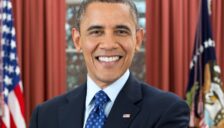
President Trump’s First Term

New Yorker:

Trump aides are organizing what one Republican close to the campaign calls the First Day Project. “Trump spends several hours signing papers—and erases the Obama Presidency,” he said. Stephen Moore, an official campaign adviser who is a senior fellow at the Heritage Foundation, explained, “We want to identify maybe twenty-five executive orders that Trump could sign literally the first day in office.” The idea is inspired by Reagan’s first week in the White House, in which he took steps to deregulate energy prices, as he had promised during his campaign. Trump’s transition team is identifying executive orders issued by Obama, which can be undone. “That’s a problem I don’t think the left really understood about executive orders,” Moore said. “If you govern by executive orders, then the next President can come in and overturn them.”

Terrifying column.

Barack Obama and Doris Kearns Goodwin: The Ultimate Exit Interview

Obama

Vanity Fair:

OBAMA: It’s always dangerous to amend the words of Abraham Lincoln, but let me see if this is a friendly amendment. I actually think, when you’re young, ambitions are somewhat common—you want to prove yourself. It may grow out of different life experiences. You may want to prove that you are worthy of the admiration of the demanding father. You may want to prove that you are worthy of the love of an absent father. You may want to prove that you’re worthy of other kids or neighbors who were wealthier than you and teased you. You may want to prove that you’re worthy of high expectations. But I do think that there is a youthful ambition that very much has to do with making your mark in the world. And I think that cuts across the experiences of a lot of people who end up achieving something significant in their field. I think, as you get older, that’s when your ambitions become “peculiar” …

GOODWIN: Oh, well said, sir. We can amend Lincoln.

OBAMA: … because I think that at a certain stage those early ambitions burn away, partly because you achieve something, you get something done, you get some notoriety. And then the particularities of who you are and what your deepest commitments are begin expressing themselves. You’re not just chasing the idea of “me” being important, but you, rather, are chasing a particular passion.

So, in my case, you could analyze me and say that my father leaving and being absent was a motivator for early ambition, trying to prove myself to this apparition who had vanished. You could argue that me being a mixed kid in a place where there weren’t a lot of black kids around might have spurred on my ambitions. You could go through a whole litany of things that sparked me wanting to do something important.

But as I got older, then my particular ambitions started cohering around creating a world in which people of different races or backgrounds or faiths can recognize each other’s humanity, or creating a world in which every kid, regardless of their background, can strive and achieve and fulfill their potential.

And those particular ambitions end up being rooted not just in me wanting to prove myself, but they end up being rooted in a particular worldview, a recognition that the world only makes sense to me given my life and my background if, in fact, we’re not just an assortment of tribes that can never understand each other, but that we’re, rather, one common humanity that can meet and learn and love each other.

I loved this entire interview.

When a Crackpot Runs for President

The New York Times

Nicholas Kristof, at The New York Times:

There are crackpots who believe that the earth is flat, and they don’t deserve to be quoted without explaining that this is an, er, outlying view, and the same goes for a crackpot who has argued that climate change is a Chinese-made hoax, who has called for barring Muslims and who has said that he will build a border wall and that Mexico will pay for it.

We owe it to our readers to signal when we’re writing about a crackpot. Even if he’s a presidential candidate. No, especially when he’s a presidential candidate.

How Breitbart Conquered the Media

Ta-Nehisi Coates, writing for The Atlantic:

Events on Friday threw that thesis into doubt. Hillary Clinton made a claim—half of Donald Trump’s supporters are motivated by some form of bigotry. “The racist, sexist, homophobic, xenophobic, Islamophobic—you name it,” she said. “And unfortunately, there are people like that, and he has lifted them up.” Clinton went on to claim that there is another half—people disappointed in the government and economy who are desperate for change. The second part of this claim received very little attention, simply because much of media could not make its way past the first half. The resultant uproar challenges the idea that Breitbart lost.

Indeed, what Breitbart understood, what his spiritual heir Donald Trump has banked on, what Hillary Clinton’s recent pillorying has clarified, is that white grievance, no matter how ill-founded, can never be humiliating nor disqualifying. On the contrary, it is a right to be respected at every level of American society from the beer-hall to the penthouse to the newsroom.

A must read.

Inside the Republican Creation of the North Carolina Voting Bill Dubbed the ‘Monster’ Law

The Washington Post:

Critics dubbed it the “monster” law — a sprawling measure that stitched together various voting restrictions being tested in other states. As civil rights groups have sued to block the North Carolina law and others like it around the country, several thousand pages of documents have been produced under court order, revealing the details of how Republicans crafted these measures.

A review of these documents shows that North Carolina GOP leaders launched a meticulous and coordinated effort to deter black voters, who overwhelmingly vote for Democrats. The law, created and passed entirely by white legislators, evoked the state’s ugly history of blocking African Americans from voting — practices that had taken a civil rights movement and extensive federal intervention to stop.

This article makes my blood boil.

The Trumpster Fire Burns Bright

The Washington Post:

Fifteen months after he announced his candidacy for the presidency, we’ve almost run out of ways to describe what Trump represents. He is, without a doubt, the most dishonest candidate to run for the presidency in modern history, and perhaps in all of American history. It isn’t even close, and that should be beyond dispute by now. It isn’t just about his habit of stating alleged facts that are demonstrably untrue, and continuing to repeat them even after it’s been pointed out that they’re false, though that’s part of it. It’s also about the sheer volume of unreality he delivers, as though he’s trying to drown us all in a river of bull that moves so fast that truth itself begins to seem almost irrelevant.

Flooding of Coast, Caused by Global Warming, Has Already Begun

Science

Remember for the past 15 or so years whenever someone would bring up climate change and some jackass would talk about how it wasn’t real, or that it was no big deal? They were wrong.

Now, those warnings are no longer theoretical: The inundation of the coast has begun. The sea has crept up to the point that a high tide and a brisk wind are all it takes to send water pouring into streets and homes.

Federal scientists have documented a sharp jump in this nuisance flooding — often called “sunny-day flooding” — along both the East Coast and the Gulf Coast in recent years. The sea is now so near the brim in many places that they believe the problem is likely to worsen quickly. Shifts in the Pacific Ocean mean that the West Coast, partly spared over the past two decades, may be hit hard, too.

These tidal floods are often just a foot or two deep, but they can stop traffic, swamp basements, damage cars, kill lawns and forests, and poison wells with salt. Moreover, the high seas interfere with the drainage of storm water.

How to Spot the Difference Between Arial and Helvetica

Mark Simonson:

The “a” in Helvetica has a tail; Arial does not. Also, the bowl of the “a” flows into the stem like a backwards “s”; the bowl of Arial’s “a” simply intersects the stem with a slight curve. (Interestingly, the Grotesque “a” has a tail, just like Helvetica. The bolder weights of Helvetica have no tails, an inconsistency that bothers some people. Maybe it bothered Monotype, too.) Arial’s “a” has always seemed a little badly drawn to me, but maybe it’s just me.

Stop Trying to Make Anthony Weiner’s Sexting a Political Issue

Rebecca Traister, New York Magazine:

Here’s what it’s not: political news.

And yet, on what was surely one of the dumbest days of this whole campaign season — a high bar! — some in the media tried to fluff it into a scandal that has something to do with the American presidency. Which again: It does not.

Trump, of course, dove right in with a falsely congratulatory statement about how Abedin would be better off without Weiner. This was before he suggested that he was worried “for the country in that Hillary Clinton was careless and negligent in allowing Weiner to have such close proximity to highly classified information … Who knows what he learned and who he told? It’s just another example of Hillary Clinton’s bad judgment. It is possible that our country and its security have been greatly compromised by this.”

A History of Sorority Shaming on the Internet

Vox

Vox:

The video went viral almost immediately — but not because of UT pride. References to the “creepy” sound of all these women chanting, the doors to the sorority house serving as some kind of portal to hell, and the inherently basic nature of all those white women in a room together, having the audacity to bond and say words at the same time, ran rampant across the internet.

The original tweet was quickly deleted, but it wasn’t long before the media picked up the meme. Over the next several days, several major news outlets covered the Alpha Delta Pi video. New York magazine called the video “deranged,” insisting, “Their screams will haunt you, but not as much as their wiggling fingers, their manic chants, and the disembodied arms clapping in the background.”

But as anyone who’s lived on a major university campus in the fall can probably tell you, all sororities have chants. This house cheerleading is a basic, routinized component of sorority recruitment, and learning the chant is an easy way to bond with potential sorority sisters. In the annals of sorority house chants, the Alpha Delta Pi one is easy to learn and good to use in a recruitment video, to teach any potential recruit the chant before they show up to the event. And the way the chant plays out, with a sorority “door stack” behind those grandly opening doors, is a longstanding tradition among sorority houses:

Was it just this particular video that rubbed the internet the wrong way? Of course not. As sororities have moved online, incidents involving the public shaming of sorority girls have increased. Here’s a brief look at the many ways sororities and their members have taken heat on the internet.

How Donald Trump Got His Start, and Was First Accused of Bias

The New York Times

The New York Times:

She seemed like the model tenant. A 33-year-old nurse who was living at the Y.W.C.A. in Harlem, she had come to rent a one-bedroom at the still-unfinished Wilshire Apartments in the Jamaica Estates neighborhood of Queens. She filled out what the rental agent remembers as a “beautiful application.” She did not even want to look at the unit.

There was just one hitch: Maxine Brown was black.

Stanley Leibowitz, the rental agent, talked to his boss, Fred C. Trump.

“I asked him what to do and he says, ‘Take the application and put it in a drawer and leave it there,’” Mr. Leibowitz, now 88, recalled in an interview.

It is terrifying this man has any support for public office in our country.

How AI and Machine Learning Works at Apple

Backchannel:

This story of Siri’s transformation, revealed for the first time here, might raise an eyebrow in much of the artificial intelligence world. Not that neural nets improved the system — of course they would do that — but that Apple was so quietly adept at doing it. Until recently, when Apple’s hiring in the AI field has stepped up and the company has made a few high-profile acquisitions, observers have viewed Apple as a laggard in what is shaping up as the most heated competition in the industry: the race to best use those powerful AI tools. Because Apple has always been so tight-lipped about what goes on behind badged doors, the AI cognoscenti didn’t know what Apple was up to in machine learning. “It’s not part of the community,” says Jerry Kaplan, who teaches a course at Stanford on the history of artificial intelligence. “Apple is the NSA of AI.” But AI’s Brahmins figured that if Apple’s efforts were as significant as Google’s or Facebook’s, they would have heard that.

For the Colonel, It Was Finger-Lickin’ Bad

Food

From The New York Times archives, Colonel Sanders visits a KFC in 1976 and is pissed:

And when told that many Kentucky Fried Chicken salesclerks packed hot chicken in buckets well in advance of its sale, he almost fumed. If they do that, he said, the chicken will have a terrible smell.

“You know, that company is just too big to control now,” he said, “I’m sorry I sold it back in 1964. It would have been smaller now, but a lot better. People see me up there doing those commercials and they wonder how I could ever let such products bear my name. It’s downright embarrassing.”

Blonde Bombshell

A great takedown of the insufferable Bob Lefsetz from Nick Heer at Pixel Envy:

The gist of Lefsetz’s piece is that the exclusive-to-Apple Music release of “Blonde” is, somehow, the canary in the coal mine of the music industry. That its exclusivity is, somehow, a symptom of a music industry that doesn’t know how to build a fanbase and is, instead, spitting in the face of everyone from committed fans to casual listeners.

But, for some reason, Lefsetz is only angered now by the release of Frank Ocean’s record on Apple’s platforms.