
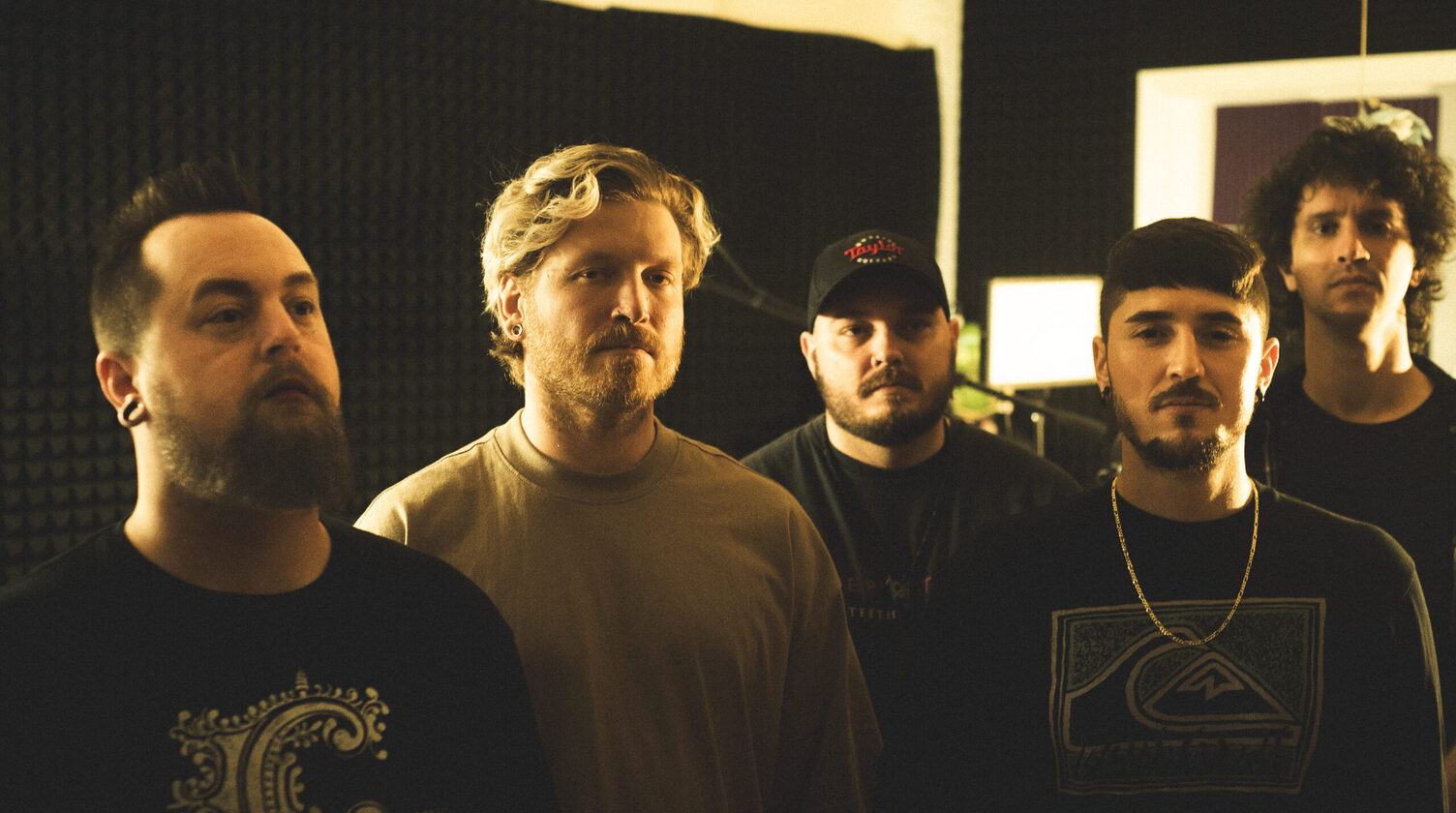
Recently I was able to connect with a high-energy rock band, called Run The Riot, that has a slick punk sound paired with a little bit of a metal edge to their approach to songwriting. In this interview I asked the band members about their core influences, how they formed and wanted to play music together, and a dream concert lineup that they’d jump at the chance of making happen. Run The Riot is Nick Rubright (Guitar), Bradley Klein (Bass, backing vocals), Billy Waas (Drums), Vlad Odiiak (Guitar, backing vocals, production), and Joe Voccia (Lead vocals), and they’re ready for their moment. If you’re enjoying the interview, you can check out all the streaming and related links to the band here.
Thanks for your time today! I understand that your band is doing everything yourselves, including no management, label or other music business help, which is very commendable. What are some of the benefits and challenges of navigating the music business on your own?
Nick: For me, I actually enjoy the marketing, so I like that DIY allows me to be creative in how we explore that. As a band, the biggest benefit is something that I think will compound later, in that we own our music and we aren’t sharing our rights. The biggest challenge is a lack of money. We need to fund everything on our own, but I think in doing that, we build a stronger foundation that will be more lasting, and we aren’t subject to more traditional industry restrictions.
Bradley: That’s correct. When you’re just starting out with a project, money, time, and notoriety are easily the biggest hurdles for growth within the music industry. A massive benefit to DIYing everything is being able to allocate our finances more productively. Yeah, we could spend money to hire a manager, work with a promoter, booking agency, etc., but in our opinion it’s better to use that large amount of money towards recording, acquiring gear, professional photos, and marketing costs. But then it also becomes a challenge because we have to utilize our personal time to accomplish those tasks. Then there is also the fact that managers tend to have connections, or at least the ability to find connections more easily within the industry to help boost notoriety and growth. Everything is a double-edged sword, but we work with that we think is best as a group. We’ll most likely get a manager further down the line, but as of right now, self-promoting and managing is the better option.
Vlad: The main benefit is creative freedom. Being able to produce music exactly the way you want, express yourself naturally, stay true to your vision, own your masters and royalties, and skip the pressure of major obligations. It’s cheaper in a lot of areas, too. And honestly, there’s no one to blame but yourself. If you’re the kind of person who takes ownership and wants to grow, it pays off in the long run. The challenges… oh boy. No major media coverage, a ton of responsibilities, meeting deadlines, staying disciplined, consistently learning new material, stepping outside your comfort zone (different genres, different tones, whatever it is). Plus keeping up with digital distribution updates, metadata and licensing requirements, scheduling, communicating with collaborators, managing marketing, PR, and studio work, and that’s just the start of the list. Ultimately, most of the things labels do are available to us mortals, it’s just a matter of how much life, health, and relationships you’re willing to sacrifice to make art that fulfills you especially when listeners resonate with it. It’s a party.
Billy: This whole project has been one big, giant learning experience. We all have been playing music since a young age, and each of us have been learning little by little how the industry works. The hardest part is definitely financing this whole project. The idea is to produce something at the same quality that a signed band would bring to the table. We don’t want to do anything cheap, and we definitely don’t want to cut corners. So although it can be pricey and take longer because of that, in my opinion, it’s definitely worth it when we can step back and look at the final product. The benefit of doing this on our own is that we are in complete creative control of everything. This has been a passion project out of the gate, and to be able to experiment with different sounds and not be boxed in by expectations definitely shows in our music.
Joe: Some of the benefits are working at our own pace, being able to do things the way we want, and to be our own bosses. I enjoy building this from the ground up and really getting to learn the industry inside and out. I’m going to sound like a broken record here, but the number one con is money. Trying to find the time to do everything ourselves is also a challenge. We all have pretty complex lives, and our own share of personal hurdles.
How would you describe the music that you play in Run The Riot?
Nick: This is a challenge for me. I describe it as heavy pop-punk, but some songs lean toward metalcore, punk, or even rock. As a guitarist, I want to make songs that are an average of what I consider good guitar music. I pull lots of influence from punk/metalcore bands like A Day to Remember, Blink 182, and Yellowcard, but lots of my lead playing is influenced by metal bands and guitarists like Avenged Sevenfold or Steve Vai.
Bradley: It’s modern metalcore with a pop-punk nostalgic twist. We have some very typical pop-punk sounding hooks, then insane hardcore breakdowns in the same song. It’s fast, heavy, catchy, and each song has plenty of changes that will keep listeners interested. Some modern artists that come to mind if we were to compare our music to some are: A Day To Remember, Wage War, I Prevail, The Devil Wears Prada, The Amity Affliction, and Beartooth.
Vlad: Run The Riot’s music is like real life. It hits hard on Monday, harder on Tuesday, Wednesday tricks you into thinking it’ll ease up but somehow it’s worse than Monday, Thursday you hate everything, Friday you question all your decisions, Saturday you sleep like a rock, and Sunday when you’re honest with yourself and the people around you, you finally feel alive. You look back at the week, see the meaning behind the chaos, stay up too late enjoying the tiny pocket of peace you get… and then Monday hits again after five hours of sleep. That’s our music. Beautiful chaos with emotional jump scares.
Billy: I like to say we’re a heavy pop-punk band with metal influence. We play what we like to listen to, and we all have a similar yet pretty eclectic taste of music. When people hear Run The Riot, they’re definitely going to know it’s us. We have a pretty unique sound, and we’re ready to share it with the world.
Joe: I would describe our music as fun, energetic and versatile. It has a lot of heavy elements, but also a lot of groovy riffs, and catchy melodies. It’s kind of a difficult question because we don’t really fit into any particular genre. We just kind of go off of what we all like as a whole. It’s a total combination of all of our combined influences.
What was each of your band members’ music upbringing like at a young age, and do you think that played any role in shaping your music tastes as a unit today?
Nick: I actually didn’t start listening to music until I was around 14 because that’s when I started discovering more guitar-driven music, which fit my preferences. A lot of friends listened to rap and hip-hop, and it just wasn’t my jam. I started playing guitar and getting more involved in music when I was around 16, after my high school girlfriend dumped me. I was mostly self-motivated and self-taught, and learned a lot of technical stuff and music theory on YouTube. It was a way to get through tough times like that for me. There wasn’t a lot of push from my family to pursue music, but my family is very musically inclined. It was more just driven by passion and a need to channel my feelings into something.
Bradley: My parents raised me listening to a lot of ’70s and ’80s classic rock. Styx, Kansas, Boston, Lynyrd Skynyrd, Ozzy Osbourne, Elton John, and Billy Joel. But as I started to find my own music taste I gravitated towards Green Day, Fall Out Boy, Sum 41, Lit, and Blink-182. That eventually led to the “scene” era of Paramore, Panic! At The Disco, The Red Jumpsuit Apparatus, and the like. Then as I got into my later teenage years I found a greater appreciation for heavier music by discovering Beartooth and listening to a lot of the album “Homesick” by A Day To Remember. Everything I’ve written seems to tie into the powerful choruses of classic rock, fast-paced and catchy pop-punk compositions, and finding ways to to tie it all together with inspiration from bands in the modern post-hardcore/metalcore scene.
Vlad: My childhood pretty much dictated my interest in music. I had no control over it, so embracing it was the only option. Growing up, my dad would play Michael Jackson, Metallica, Deep Purple. Both my parents led a worship group at church, and that’s where I ended up playing in my first punk rock band at 14. Before that, I was discovering music on my own, staying up late watching Sum 41 on TV, listening to Linkin Park, Three Days Grace, Blink-182, Avenged Sevenfold, NOFX, Green Day, Slipknot, AFI, Rancid, Limp Bizkit, Good Charlotte… even though half those bands were “prohibited” by my parents’ views. My dad did gift me Dead Letters by The Rasmus though, and I somehow got a Linkin Park record that sounded like a bootleg, loved it to death. Later I got into metal, punk, emo. I wrote for another punk band during my time in music pre-school while studying piano, choir, orchestra, classical guitar, singing, conducting. Then I went to university for classical guitar, drums, jazz orchestra work, and conducting, while playing in punk, melodic hardcore, and metalcore bands that sound like A Day To Remember (been a fan since And Their Name Was Treason), It Prevails, Comeback Kid, For The Fallen Dreams, etc. I was also influenced by classical, hip-hop, pop, jazz, deathcore, basically everything. Everything changed after I heard Periphery and learned about Misha Mansoor recording in his bedroom with a Line 6 POD. It blew my mind, not just creatively, but the fact that you could do it yourself without relying on anybody. From that moment I became fully DIY. With enough focus, time, effort, and a little money, anything’s possible. Now I can make music anywhere I go. All of that shaped me, and I think all our members have had their own versions of this wild musical upbringing. That’s why our tastes lock in so well today.
Billy: As a child, I can remember my mother rocking out to Matchbox Twenty and The Wallflowers. My father was a classic rock kinda guy. Pink Floyd, Led Zeppelin, Jimmy Hendrix, the list goes on. I still enjoy all of that music, and as I got older I definitely leaned hard into the pop-punk, emo, scene kid era. Progressive rock and metal was also something I fell in love with. The complexity and technicality of it made me want to push my skills to the limits. I feel it opened my mind to different sounds and styles. I try not to box myself in with one specific genre. I like to explore what’s out there, and I’ll give just about anything a chance. As a unit, we all are super passionate about pop-punk music, and I feel like we are all on the same page about what we want this project to sound like.
Joe: My biggest influence is ’90s alternative rock. Linkin Park comes to mind as one of my biggest influences. Avenged Sevenfold, System of a Down, Three Days Grace, and Silverstein just to name a few. I started playing guitar at the age of 12, because I was inspired by these amazing artists. I started singing shortly thereafter, because who doesn’t like to sing along to their favorite songs, right? I think this type of music really pushed me to train my voice, so I can bring the same emotional energy through clean and dirty vocals in our songs.
What drew each of you to wanting to play music together as Run The Riot?
Nick: I actually moved to Tampa, Florida, to start or join a band. I had met lots of people before meeting Billy, our drummer, and jamming with him felt right because it was natural and easy to come up with ideas that we liked. Billy and I jammed what is now the intro to “Falling Down” very soon after meeting, and that was sort of a foundational piece for recruiting other members. He and I recruited the rest of the guys. We really wanted to make this into something that we want to spend the rest of our lives doing, with people whom we wouldn’t mind spending time with for the rest of our lives. This is hopefully a lifelong venture for us, and I was looking to work with people who felt a similar way.
Bradley: I was the last to join. I had a pretty tumultuous falling out with my previous band due to a bandmate with some toxic personality traits. I stepped away from that band in March of 2025. I don’t remember if I added Nick (our lead guitarist) or if he added me on Facebook, but I saw that he posted about his band “Run The Riot” needing a bassist. I’m primarily a vocalist and guitarist, but bass is my favorite instrument to play. After that nasty band breakup I needed a break from the music scene for a while, so I scrolled past Nick’s post without a second thought. I saw another post from him about a month or so later, and I seriously considered it. But I decided I still wasn’t ready yet. Then I saw another one of Nick’s posts about Run The Riot needing a bassist another month later. I said, “Screw it” and decided to message him. The rest is history.
Vlad: All our experiences lined up, growing up with similar emotional baggage, similar hopes, similar struggles, and similar sounds that gave us an outlet to rage, riot, and still feel hope in the process. Everything we’d envisioned for years somehow aligned at the right moment. It brought us to here, to this band, to this project that feels like the most natural collaboration any of us could’ve ended up in.
Billy: I moved to Florida the summer of 2020 from Connecticut, and wanted a fresh start. Music was big on my mind because I knew the Tampa scene was pretty good for what I wanted to do musically. Once I got all my ducks in a row, it was time to start looking for people to jam with. Facebook local musicians groups were where I started looking for like-minded people. I met Nick through a friend from another project, and from there we started to click. We went through several musicians until we found the right fit. As Nick likes to say, “If it’s not hell yeah, it’s no.” The most important part was that we wanted to make sure that as members, we are also a tight-knit family. The members are the foundation so we worked tirelessly on making sure everyone we tried out was a good fit. I think we did it.
Joe: Nick’s sick guitar riffs, with his vast range of chugs and widdleys, really caught my ear. Billy’s double bass and groovy fills really complemented the guitar melodies just right. Initially the band only needed a rhythm guitarist, so I decided to give it a shot. Things were going pretty well until the vocalist at the time dropped out for personal reasons. We were left without a singer, auditions weren’t going well, so one day the boys encouraged me to write some vocals to a demo we were working on at the time, just for shits and gigs. To all of our surprise (including mine), we had a banger on our hands. We ran with it and ended up releasing it as our debut single, “Falling Down.”
I checked out your website and I saw you offer a comprehensive VIP membership that includes access to all of your music, guaranteed meet & greets at shows, and other access. How did this idea come together?
Nick: We’re always brainstorming merch ideas. The idea came from wanting to get closer to the people who care about our music. We’re still a growing band, and every stream, every message, every person at a show actually matters to us. We kept thinking, how do we make something that gives fans more than just merch or early access? So the VIP membership kind of became our way to build a real community. It gives you everything we release, guaranteed meet & greets at every show, behind-the-scenes stuff, early demos… all the things we’d want if we were fans of a band. It also helps us stay independent and keep making music without relying on labels or huge budgets. At the end of the day, it’s less about specific perks and more about building something with the people who’ve been supporting us from day one. It means a lot to us, and we want it to feel like a two-way connection, not just a subscription. There absolutely will be special surprises in this that are not listed on the website, like random song demos or group gaming sessions, which I think keeps things exciting!
Bradley: It was originally Nick’s idea. Not only is it a cool way to connect with fans who support us and want us to succeed, but it’s also a way for us to keep funding our recording sessions and gear acquisition for the future. It’s kind of like a quid pro quo deal. Supportive fans get to know us on a personal level, and we get to keep creating music for them.
Vlad: People who care about art deserve to experience it fully. Fans who support artists deserve to feel like part of the experience, directly or indirectly. The VIP membership is our way to build a community of people who genuinely resonate with what we create. If someone wants to join that family, we welcome them. At the end of the day, we’re still just dudes who want to eat pizza, stay up late, and hang with the boys
Billy: We want to do something different. Having a genuine connection with our fans is important to us, and the more we connect with the people, the more I feel this project will really take off. It allows the listener to really follow along with our journey. We hope to inspire others to really put themselves out there, and this gives us a great opportunity to share our journey, and make our fans feel as though they are a part of it.
Joe: I would have to give credit to Nick because he’s our marketing mastermind. It’s a great way for us to connect with our fanbase and gain closer relationships with people who wish to share in this journey with us. We’re going all the way and want to be able to show our support back to those who support us. We thought this would be a great way to tie these things together.
Where do you find inspiration in writing the music that becomes Run The Riot?
Nick: I get lots of my inspiration from shows. If I go to a show and the moshing is wild and the crowd is engaged with the music, that’s what excites me. I always want to write riffs, breakdowns, or melody lines that make people feel something intense and make them want to move.
Bradley: My answer won’t be as in depth as the other members because I’m still new to the band, but I’ve always found inspiration in my struggles with panic disorder, depression, and anxiety. But also love, loss, perseverance, and finding a way to keep my head above the water through it all. Instrumentally, I find inspiration by jamming along to a track or idea that Vlad, Joe, or Billy has come up with and just having fun until I find something that sounds really good and meshes well with the other instrumentals/vocals.
Vlad: In myself, my experiences, my traumas, the world, and the people around me. Everything that starts eventually has to be resolved somehow, and my way of resolving life is dedicating myself to music. I went through war, loss, displacement. I lost my home, my studio, my city, my family’s house, everything I’d built. Moving from Ukraine to the US and connecting with Nick felt like something that was meant to happen. None of us questioned it. It was natural.
Billy: Music to me is a great way for people to connect. When I go to a show, it’s great to see people of all different walks of life being brought together by a common appreciation of the music. Most of my closest relationships stemmed from a common interest in music, and it inspires me to create something that can bring people together.
Joe: My biggest inspiration to write music with this band comes from personal experiences throughout life. The band does a great job of putting instrumentals together that tell a story all their own. And it’s my part to fill the gaps and really give them a voice.
If you were in charge of building out a 4-band concert lineup, including yourselves, who would you ideally choose to get paired with, and what do you think your band could do to enhance that show?
Nick: A Day to Remember, Avenged Sevenfold, Rise Against, and Run The Riot. I feel like these bands kinda fit our average vibe, and this would be a sick lineup. As for what we’d bring to the show, we’d want to kick the night off with the kind of intensity that sets the tone early. Our goal would be to bring that mix of sing-along hooks and heavier moments that gets the crowd warmed up and makes the whole lineup feel cohesive. We’re big believers in putting on a show that feels like an experience, not just a setlist, so we’d be dialled in on crowd interaction, big moments, and making sure fans walk away thinking, ‘Damn, that whole night was insane.’”
Bradley: I would love it if we could play with Not Enough Space, Wage War, and A Day To Remember. All of those bands have so much energy and talent, and I feel like every attendee would leave feeling fulfilled knowing that their money was well spent. Our music is very high-energy, and that would set the tone for Not Enough Space to blow everyone away even more. Then two metalcore/post-harcore giants like Wage War and ADTR to top it off? That would be such an amazing night.
Vlad: A Day To Remember opens up. Periphery tears everything apart. Blink-182 brings their mom jokes and the rare songs they never play live. Run The Riot closes with a 2-hour set backed by an orchestra, like Metallica in the early 2000s. Everyone cries, hugs, confetti explodes everywhere. The venue staff wonders how long cleanup will take. We start dismantling gear and loading trucks while hanging out with our favorite bands. I wanted to include more bands, but you’re not giving me much choice here, lol.
Billy: Bring Me The Horizon, Blink-182, and State Champs. It might be an unconventional line-up, but they were definitely the first that came to mind. There’s so many other amazing bands out there I would be interested in playing with but I’d say these guys are by far some of my favorites. I think where we really stand out is our vocal harmonies. Most bands have some but I feel like vocal harmonies are a big part of our sound. That’s what we bring.
Joe: I would say Silverstein, Rise Against, and Pierce the Veil would be a solid lineup for us. These bands bring a lot of energy and showmanship to the stage. I feel like we fit right in with those bands given the type of music that we write. We as a band would be able to bring a consistent level of energy and I think together we’d be able to give the crowd a killer time.