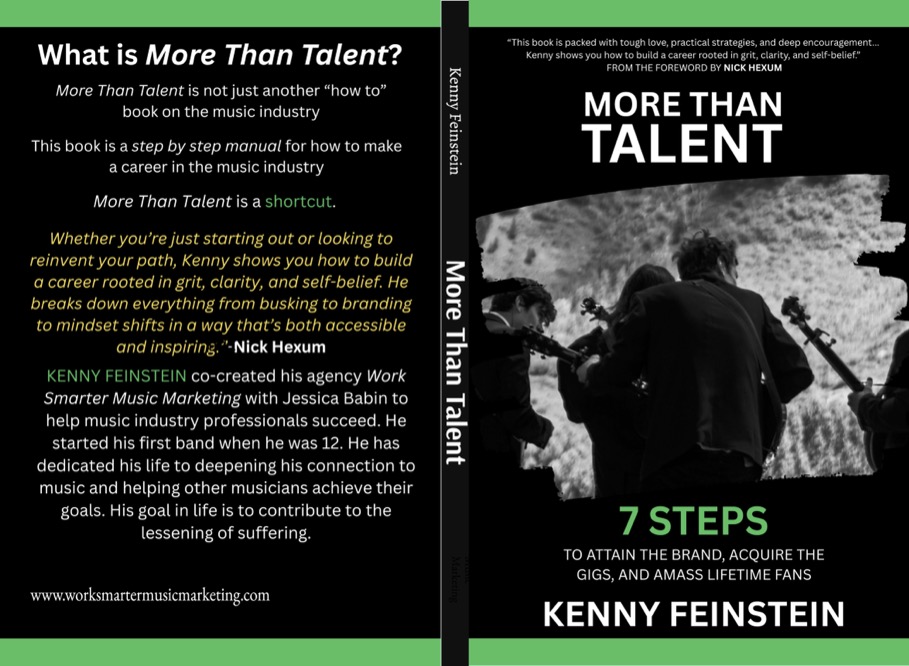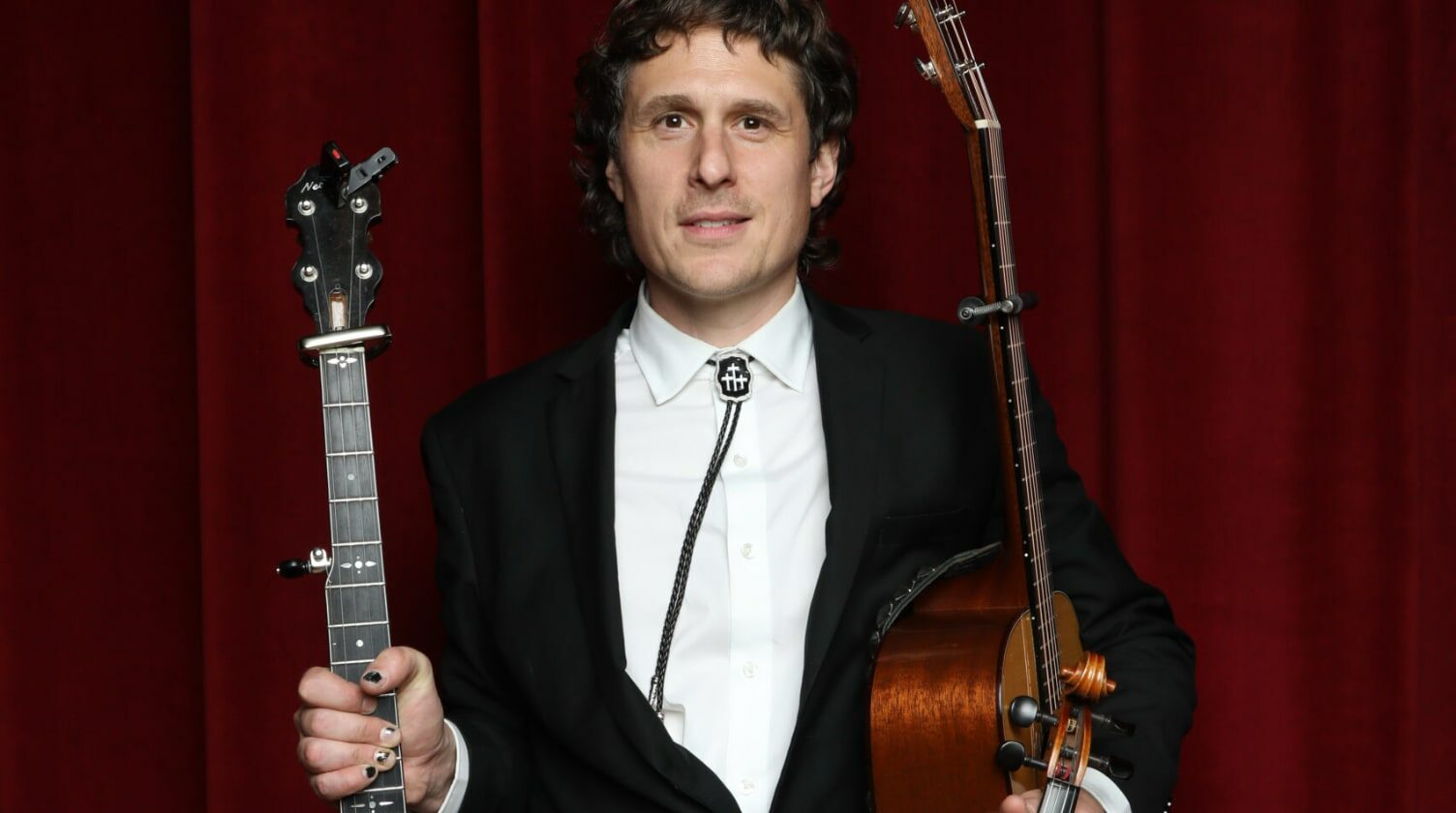
This past week I was able to schedule a Zoom call with musician turned author, Kenny Feinstein, to discuss his new book called More Than Talent: 7 Steps To Attain The Brand, Acquire The Gigs, And Amass Lifetime Fans. In this interview, I asked Kenny some in-depth questions regarding these seven key steps, what mistakes most new artists are making today, and how he views the music industry changing today. The book officially released today, and you can order it here.
Thank you so much for your time today, Kenny. Your new book, called More Than Talent: Seven Steps to Attain the Brand, Acquire the Gigs, and Amass Lifetime Fans, comes out July 1st. What inspired you to put your lessons learned from a lifetime in the music industry into a book?
Personally, Adam, thank you for having me. I am a big fan of Chorus.fm, and just honored to be talking to you. And yes, to answer your question, I’ve been in the music industry really since I was 13 or 14, playing in punk bands, and then I got into playing Bluegrass in the country, and all this stuff. And I just love music, so it was an accident that I got into the music industry, because I started with just loving music and being like I don’t want to do anything else. And when I was busking my first time at 14, and I got a $5 bill, I was playing “What’s My Age Again”, or something, and that kind of changed it all. I was like, what if I could make money doing this? So I went ahead, full force, doing the music thing from a kid, and had a lot of success at a young age. At 19, I was touring the world, and having a lot of success in my band, but kind of did a lot of things the wrong way. And now it just sort of struck me, because I’m doing the band thing now in this modern age, using social media, mailing lists, all that stuff. And once the pandemic hit, I sort of decided to learn all this stuff, because before that I would be “punk rock”, and I was like, “I’m not gonna learn any social media…” I’m against all that stuff, right? And also, I was standing at the freeway off ramp with my band every single day for many years, honing our craft, making our living at a freeway off-road in Los Angeles. So I was like, we’re gonna make our fans one at a time, pandemic hit, and I was like, alright, we can’t be the freeway offering. It was time to go online. So I read all these books, I took some classes, I did a lot of experimentation, decided I wanted to figure it out online, and all my friends started coming to me and being like, “How do you do that? Can I pay you to do that? Can I pay you to do this for me? Can I pay you to teach me?” And eventually, me and my friend Jessica were like, “Hey, I can’t do this.” So we just had Jessica learn it, and now they would hire her, and I would help too, but I was always focused on Water Tower, so it was really an accident with needing to make money playing music when the old way went away from the pandemic, and that’s that’s really how it happened. And the book struck me like lightning. I was walking around, and all of a sudden it came to me…I was like, I kept saying the same thing to literally hundreds of musicians, the same exact thing day in, day out. And I’m like, let me just put this in a book so people could read it. And man, it hit number one in all three categories last week. I’m really excited!
That’s awesome. Congrats on the early success of the book, even before it has come out. So kind of reminds me of that quote from The Dark Knight. The Joker says, “If you’re good at something, don’t do it for free…”
Oh, I love that. Yes, so true!
What did you find are some of the most common mistakes that, or missteps, that young bands pursue in today’s music industry?
It’s a really good question. Well, the first one is, it really has to do with addiction, and it’s not necessarily a mistake, it can be, but with drugs and alcohol, and anything like that, it takes away from the mission. It’s extracurricular in this industry, it’s very accepted, and so it’s easy to go down the path of that, and that was a big misstep on my journey. Although, I’m grateful for my experience, because it brought me to where I am today, and addiction taught me <give> devotion to one thing at all times, and that’s the energy that I bring to things today. So I’m grateful for it, but that’s one of them. Specifically in the music industry, I think one of the things is missing out on a mailing list. A mailing list is central to any business, but especially to a music business, because the Grateful Dead were really the very first people to have to do this. I think it was in 1976 they put out one of their records and they said, “How are you? Where are you? And they basically started their mailing list, and it’s huge now, but they were really the first band to ever do that, and start writing their fans back. Because social media can go away at any time, and all of a sudden, “oh, I’m locked out of Facebook, that’s it.” But you always have your mailing list, and you could mail them and say what’s up, so making sure that we invest in nurturing the relationship with our subscribers and really providing value for them, because they’re the ones who are our hot traffic, and who want to be on the inside circle with us. And then the other one is not posting reels every day on the big four platforms. If there’s a musician who’s young, or any age, if there’s a band who wants to make it if you’re not posting reels every single day on all the big four. When I say the big four, I mean: Facebook, Instagram, YouTube, and TikTok. Then there’s not really a chance…
Yeah, I mean it’s tough to kind of get the word out there these days. So mailing lists and social media are big, big booming industries today. So, how quickly do you think the music industry has changed since, let’s say, 20 years ago?
Oh, man. It’s always changing, so much change in what was 20 years ago is 2006. So, well, I remember that, I remember blogs, like Pitchfork, were such a big deal back then. YouTube was already a big deal, but Napster in ‘99 changed <the industry> so much. But from 2006 to 2026, the craziest curve I would have to say is really just that the pandemic changed everything. And what I call the great TikTok interruption…TikTok came in and was like, this is the way we’re all doing it now, and if you don’t do it like this, you have no chance.
And do you think TikTok ruined people’s attention spans from a music consumer type of point of view?
It’s a great question. I don’t think it necessarily ruined it. I know a lot of people would say that, but to me, it almost sharpened everyone’s attention, because yes, there’s literally a scientific thing going on. The science behind what’s happened to our brain and our attention span, the dopamine and the addiction that we have with our phones is a thing. But the good side of that is that it has, we have to learn how to have brand clarity immediately, and the “elevator pitch” is now “the four second pitch”. You had about 25 seconds <before>, now you’ve got four. I mean, most people on average drop off around 1.8 seconds on a video, so we have to distill our message and our brand clarity very quickly. And I think the beautiful thing about it is that we have to understand who we are as a brand, who our listener avatars are as a brand, and who our tribe is, so we can serve them immediately with value. And so in a lot of ways, I think it made it so I had to figure out my brand clarity and my visual identity, and I have to figure out immediately, daily, on every post. But, that helped. I didn’t think it ruined it. It just made us have to zero in a lot quicker.
Yeah, you’ve got to evolve with the time. So, your book also outlines a very helpful seven step guide. I can’t wait to dive into it when my book arrives, but for bands and musicians to follow to have the best chance of success. So, the first step is to “Invest In Yourself”. What does that look like in today’s music scene? And can you think of any examples of new artists who do this particularly well in your eyes?
Yes, thank you. Yeah, it’s a seven step process, and the steps are in order for a reason, and the first thing is investing in our singing, our playing, our actual product, our look, and our marketing. Our sound system, the people around us, the team, whatever it is…but don’t be afraid to invest time and money into making our product the best it can be. An artist who I love is The Paradox. They’re one <artist> who really invested time into their social media. Their first video that went viral was just them in the room playing, playing these songs, like, Lit’s “My Own Worst Enemy” was a big one. They just spent that time being like, dudes, let’s get together in front of the phone, and we’re going to invest this time into recording. We’re practicing all the time, but yes, we’re also going to make a bunch of videos. And then they go to the gas station, they do the videos, and they do the lip sync, so they are a wonderful example. And now they’re at the top of the Billboard charts, headlining Warped Tour, and absolutely doing amazingly…and we got to see it all within a year and a half, two year process. From them in their bedrooms on TikTok to playing the very biggest stages in the world, now the number one record on Billboard. So, I love The Paradox, they really invested in themselves as far as taking the time to get the social media right now. Another artist would be Sierra Ferrell. She invests in her visual identity, and spent years busking, which is another step, but just her visual identity is a beautiful investment.
That’s awesome. Yeah, I definitely agree with The Paradox. They’re blowing up right now. Step two is dominating social media. Why is this medium so important in developing connections with your fans?
Great question. Must dominate social media, and one concept that Russell Brunson says is “dominate the conversation,” and what that means is dominate the conversation around your micro niche. So, for example, <my band> plays punk rock bluegrass. That’s a micro niche, now we must make sure that we are dominating the conversation, so anytime punk rock bluegrass comes up, oh, it’s Water Tower. I know those guys who want to make sure that everyone’s talking about it, and the way that we get everyone to talk about it is through dominating social media, making sure we’re top of mind. It takes an average of 11 to 30 touches online before someone becomes aware of your brand, so maybe it’s going to be 30 different videos that you have to see before you say, oh, I know Water Tower. I know Kenny, and then you may start joining our journey really after you’ve seen us, potentially 30 times, and staying top of mind is so important because it’s so easy to be like, “Oh, I’m watching a video. Oh, I got a text, oh, I got a notification…” and that’s why it’s going to take 30 times, and staying on top of everybody’s mind is the way that we dominate the conversation around a micro niche and ultimately dominate social media.
Yeah, that’s great advice to go by too. So, what about busking? Can you describe what is busking these days, and what it looks like? It’s not always just a guy on the corner, right, playing and begging for change, right?
Right, exactly. Busking is where we hone our craft, is where we go out and we learn to work a crowd. And in the book, I outline different ways to do that, whether it’s for a foot traffic crowd or it’s a car traffic crowd. But with a foot traffic crowd, say you’re at a mall or you’re on the side of the road somewhere, you can really get someone’s attention with one song, then you can secure their belief with a second song, and then you can sell the CD with the third song, or get them on your mailing list, and really pull them into your ecosystem. So it’s like a three song <concept> because most people are not even going to stay for three songs, but some people will, especially if they’re quick and you do it in the right way…so we have to figure out the right emotional connection, and we also have to be looking at the crowd to understand the emotions of them. But the beautiful thing about busking is that the playing field is level, and people are coming up here and they want to believe in you, but it’s tough to win them over. So busking teaches you how to emotionally win these people over through your music, through your melodies, and through just moving them in this sort of existential capacity. Because people want to connect with us in an existential capacity, so if we can understand how to connect with people on the street, we can do it on any stage, anywhere, no matter how many people are watching. And that is the toughest way to do it. It’s the cheapest way to do it, and I think it’s the best way to do it, because practicing in your room, you’re not going to have that connection. Music is about connection.
Yeah, that’s great. And what about playing shows? What are the keys to playing a successful show, and what are the best practices for promoting them as well?
That’s another great question. The successful show, there’s a lot of different ways to do it. The way that I found to do it is to make sure that the audience feels connected, that it’s a group catharsis that we feel like we’re one, and we’re going on this journey together, and so I think it’s really important to learn how to incorporate the audience into it. And that can just be by singing a song that everybody relates to, so writing good songs, but also the visual identity is so central to our show. It’s how we look when we’re on stage, and remembering that when we walk into a venue, when we walk out of our car, we’re already on stage. People are already looking at us. As soon as we pull up in the parking lot, we get on stage. It’s not just when we’re playing the music, it’s every moment of our personality that people are watching. As far as promoting shows, I still love doing flyers. I love handing out flyers. I love putting up posters on street lights, and then the mailing list. But the real important thing these days that I would love to impart to a lot of bands and artists is that you have to run an “awareness campaign.” So, if you have all the money in the world, this is going to be easy, but if you don’t, they get to think about two or three markets that you can invest in that are not too far from your house. And we only want to tour with places that have in the Venn Diagram Spotify listeners and social media followers. So I’m only going to go to a place that says, if I’m on tour, I’m going to say well, Chicago has 500 Spotify listeners, and I have 250 Instagram followers there. So I’m gonna go to try to do a show there. Now, six months in advance, I’m gonna go ahead and be running an awareness campaign in the area that looks like a viral video. So I’m gonna put five bucks behind a video that has already gone viral, and I’m gonna run it for four months in the area. And after two months, my experience will be called “creative fatigue”, which means it’s not gonna be doing as well. So we may need to replace it two months out. Then after four months, you got 100,000 views on these videos that look viral, they’re what we call “forced viral”. You retarget those 100,000 people with a new ad and say, “hey, remember this band that was going viral, they’re coming to your city!” So we geo targeted their area to people who like punk rock, and then we retarget it two months out with a ticket link, and we do that with three different markets. Have a year of the thing running a year round, like never even turn it off. You can pay five bucks a day for Chicago all year round. So anytime you want to go play Chicago, you just retarget the people who already know who you are with the ticket link and say, “hey, they’re coming here,” and yes, it’s expensive, so that’s why I say choose three markets, because if you blow up in Chicago, and then you blow up in a town nearby…Eau Claire, Wisconsin, or whatever, then you can hit those three and then hit satellites out from each one of those, and you can start to build. So if you get a nice space in Chicago satellite out to a town two hours. Then another town, two hours away from that. That way, you’re not driving across the whole country. It’s too much work to be driving across the whole country anymore. That’s how they used to do it. That’s not how it should be done anymore. It’s too expensive. If we can, we can break from our home with the right ads.
That’s cool. And do you think that people kind of cast too wide of a net? You’re talking about more targeted, social media advertising, and stuff like that, right?
Yes, I think it’s a lot of time I see artists making the mistake that they’re burning out their money and they’re burning out their bodies, because they’re like, “Oh, I have to get from New York to LA in two weeks, and I’m playing all these shows. I’m making 500 bucks a night, I got a van, and I got five guys, and the merch isn’t selling…” So the best thing to do is and the hardest thing to do is break in your hometown. And then break around your hometown. Los Angeles, which is our hometown, so we’re looking at San Luis, Obispo, San Diego, Riverside, and Temecula. Let’s go hit those every three to four months, have an ad running in those cities the whole time, then retarget them. We’re coming to <do> a show, meet the people, shake hands, do the radio show, get a little bit of press, boom, do it again three months later, boom. Then we blow up those towns. Then LA is like, “wow, you guys are blowing up in all these four towns, we’re gonna come see you!”
That’s cool, and that’s a really great way of doing that. What about the websites that sell for you? Can you provide some more insight on that step? Is that blogs, or is there more to it than that?
Yeah, blogs can help, for sure. Reading Chorus.fm, and getting to find out who they’re connected with, things like that. But what I’m talking about really is like places like Gig Salad, and The Bash sound better. There’s a whole list in my book, but for example, make sure that you’re on these websites for private gigs. We’ve gotten big gigs for people like Arnold Schwarzenegger, Good Charlotte, Katy Perry, just through being listed on a private website or a private gig website would say when a talent, a talent buyer will come through and say, put a quote and say, “Here’s the money, I’m looking for a band that does 90s covers or country songs or pop punk or rappers.” Boom. I put in a quote and say, “Hey, we can do it for this much, we’ll bring our own PA. Here’s our set list, and then, and then we can go and just play a private show, and get a little bit of money so that we can afford to tour, afford to put out our next record. Private shows are so important…weddings, wakes, parties, they’re things like that. So let me just give you a little example that happened to us recently. We’re on one of those websites, and it says we’ll travel up to 500 miles max. Then, all of a sudden, I got a bunch of calls from my friend last week, and there’s a couple friends – they’re like, ‘Hey, we just heard you on AM radio on Petros, Petros and Money show, the biggest talk radio in Los Angeles, there. The Dodgers show, and we went and listened to it, and it turns out they were just looking up Bluegrass bands near San Bernardino, and that we came up because we’ll travel up to 500 miles. They started talking about us. They went to our website. They found out that Mark McGrath from Sugar Ray was talking about us and he called us “the greatest bluegrass band ever.” All this nice stuff. And all of a sudden, that radio show is telling 1000s of people listening about how cool Water Tower is, and what Mark from Sugar Ray thinks about it. Then we went in, recorded us reacting to it, and put it out as a piece of content, and tag them in it. And now we’re building a relationship with them. I sent them my book and our CD, because we have a friendship with them. That’s all because I was listed. We were listed on one of these websites that sell things for you. Just a casual net that’s in the water at all times, catching fish while we sleep, so that’s just an example of how that can work. It really changes our career, because now we’re having these people that are gonna hire us for a show next year!
That’s awesome. I wish I would have known all this when I was playing in a cover band back in the day…<Laughter> What about a “run more more fans now campaign”? Can you delve into what this means and what these types of campaigns look like these days?
Yes, totally. So a more fans now campaign is, what do labels want, and what do bands want? We want more fans now. That’s what we want. That’s why we see labels and artists trying desperate things, putting stuff on billboards, jumping around, wearing all kinds of stuff. But the thing that gets us more fans now is a connection, and the beautiful thing is the playing field has never been more level, and there’s no more gatekeepers now, except for the algorithm. And you know, Zucky, we got to give him the money, but he has access to all these contacts, so a more fans now campaign is where it’s kind of like what I was saying about the touring. Except it’s more general, so you could run one to the U.S. in general, and say all right, five bucks a day, a video that I know is viral, and we do a testing phase first. Maybe we’re going to test five or 10 different videos, one of which is going to raise their hand as the winner. And then we’re saying, all right, put the money behind this one, and then it just looks viral, it’s a viral post. Back in 2017 is when viral videos essentially ended. We still get viral videos, but not the way we used to. It’s now “forced viral”. We do put money behind it, but we can tell because it’s going to show a spike at the beginning of the thing, and it’s going to show us through the engagements and the shares which one’s going to win. We put the money behind it, and maybe it’s the whole U.S., and then we start to see where our people are. Like, oh it’s optimizing for North Carolina and San Francisco, boom. Then we can turn off the rest of the country and be like, I’m gonna optimize for these cities and bring these people into our mailing list, into our ecosystem, and if we’ve really optimized our ecosystem, then we reduce any waste on the fan journey. It’s all about the journey of the fan, which is ultimately a seven step process as well. But thinking about how we’re introducing people through our social media, we’re educating them through an automated process. We’re getting permission to market to them through their email, we’re kind of nurturing the relationship until they affirm the relationship by buying something from us, then they ascend our value ladder by coming to our show. Which requires driving out, paying for parking, getting some food, getting a ticket, spending all night there. It’s very expensive. It’s a fifth step type product. And finally, word of mouth referral. You’ve got to go see this band, they’re amazing.
And do you think the common person knows just how much data is out there on them on these social media sites that they’re a part of?
Good question. <Laughter> No, whenever I talk about that with anybody, they’re very surprised. Yeah, Meta, at any given time, has 52 million data points on a single person at any one time. So, Meta knows us better than our wives, than our best friends, and better than ourselves. Meta knows our heartbeat. Meta is at every point of purchase at every store, Meta is there taking the data at every stop light, Meta is there beaming up where we are to our car. But not just Meta, but Google and Byte Dance, and all this kind of stuff. So all these companies in the age of surveillance capitalism know us better than ourselves and sell that information around. And it’s still the wild wild west, but it’s not a big deal if you’re not doing anything crazy. I don’t care that I’m surveilled, really, because I have nothing to hide. In fact, I use it to my advantage. I think that’s the most punk rock thing you can do, is take the system, use it against them, so that you can make a living.
That’s absolutely true. I mean, that’s a great way of looking at it. And the last step is dominating your mailing list. Do you have recommendations on which mailing platforms provide the best metrics to let bands know if your message is getting out there or not?
Oh, that’s really good. There’s a lot of great ones. Mailchimp is a classic, Constant Contact is a classic, Drip is a classic. I use a CRM, a customer relationship manager known as Indy Pro, which is white labeled to go from a high level..but what I’m saying essentially is get into a CRM if you’re serious about this, get a customer relationship manager. Now, if it’s a band just starting out, get on Mailchimp, Constant Contact, or Drip. But the thing about a CRM is that I have a lot more granularity and control, and there’s a lot I can automate when someone comes into our ecosystem on our website. I have a four day email series that provides value. In the first email, I’m giving them access to a private link of a documentary about the band with a five angle HD beautiful YouTube link that they can watch. They can only see it if you come on through there. Then I nurture them, and by the third and fourth email I’m making an offer, because they already know about us. Now they’ve come on this four day journey, and the offer has our CDs, our vinyl, our tape, our documentary, shirts, all these kinds of different packages that are exclusive to the email list. Because they’re lower prices than they would be anywhere else. So all that to say, a customer relationship manager, like Go High Level or Indie Pro, but I would actually recommend Indie Pro. It’s very helpful to keep the relationship with the customer managed, because it aggregates communication between Instagram and Facebook and emails, and it automates ourselves, so that we can make these sales. And you can also build courses on there, and there’s a whole lot of metrics, and get really granular with it.
This has been awesome, Kenny! I’ve already learned a lot, just even before I dove into the book. So, if you were to convince someone, like a new or emerging artist, to check out your book after reading this interview when it comes out, what would you tell them?
I would tell them this is the manual that I wish I had growing up. I wish that I had someone to just cut through it all, and just tell it for me. I need very simple instructions, and I want to know how to do it right now, because I’m extremely impatient. I’ve read all the different books, and I recommend reading all the different books. Donald Passman – he really is the Bible. How to make it in Mexico Street, the Ari Hairston book. There’s all these amazing books, but for me, I wanted to come with the shortest possible, quickest way to get there that gives me a step-by-step thing. So, if you want to make it in the music industry, and you want to get started right now, and you want to get there as fast as possible, this is the seven step manual to do it. And for dabblers, take one step at a time and spend a year. And for dominators, devour the whole book in a day, and take it all on, and in a year, your whole life’s gonna look different. You’ll never have to worry about money again if you do these things.
That’s awesome. Thank you so much for your time, Kenny!
I appreciate you, Adam. I love what you do, and thank you so much for your time, buddy!