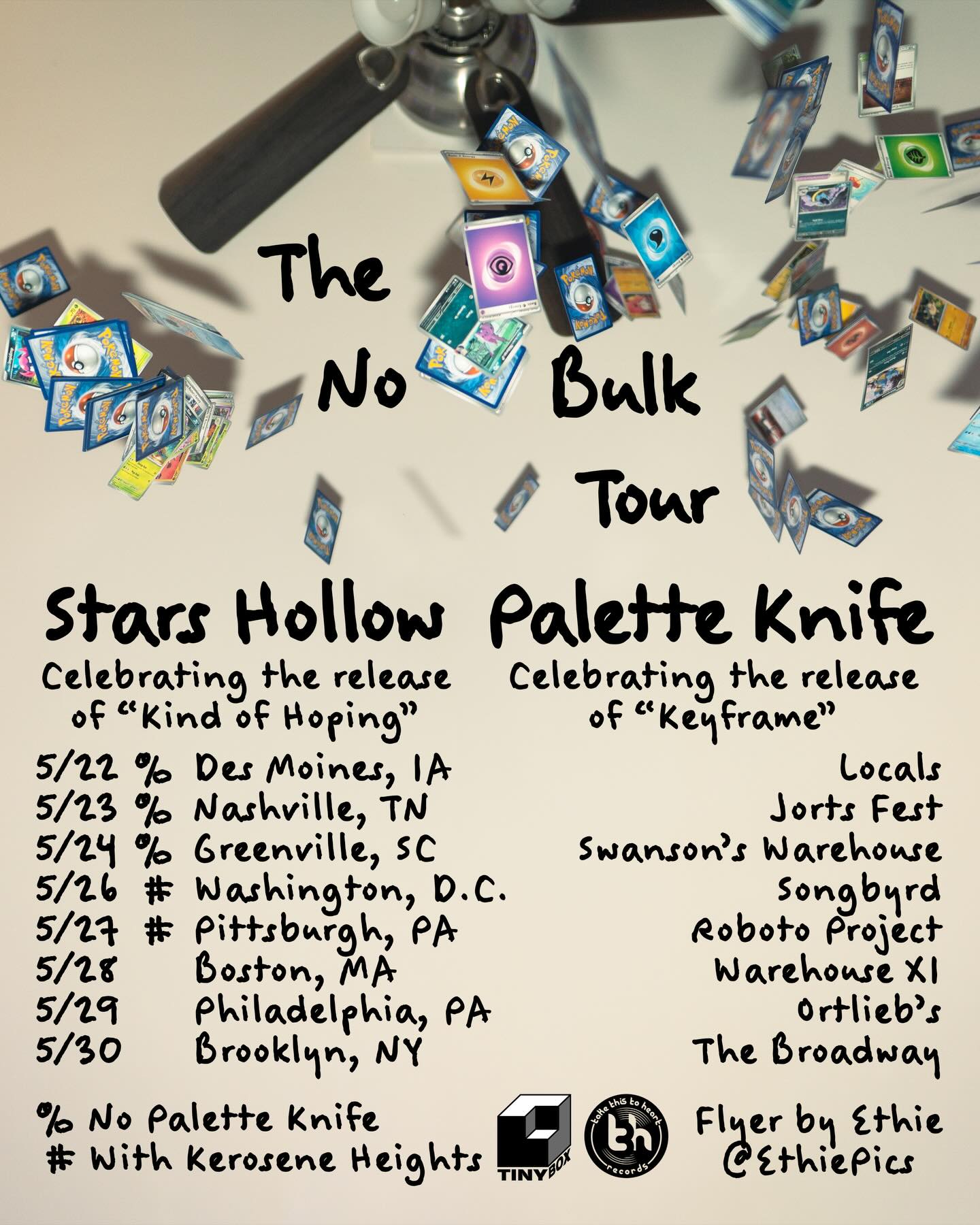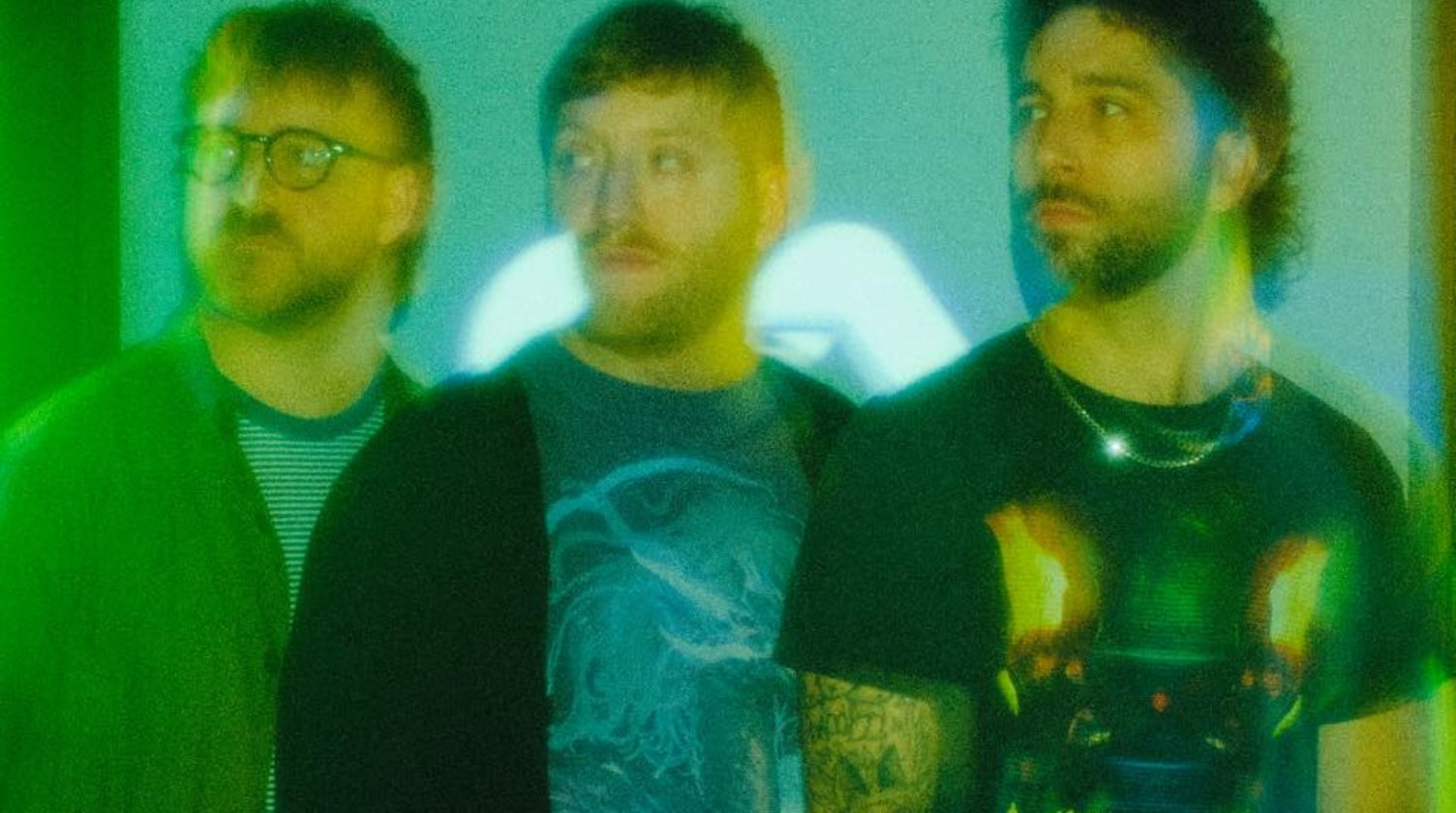
A couple of weeks ago I was able to schedule a Zoom interview with Palette Knife to discuss their forthcoming new album, Keyframe, that drops on all streaming services this Friday, April 10th. Palette Knife is a three-piece emo band comprised of band members Alec Licata (vocals/guitar), Chris McGrath (bass/vocals), and Aaron Queener (drums). In this interview, I asked the band about some of the songs found on Keyframe, their writing process, and upcoming touring plans. If you’re enjoying the interview, please consider pre-ordering Keyframe here.
Thank you guys for your time today! Palette Knife recently released their second single from this upcoming record, Keyframe, called “Mimic.” Can you walk me through your band’s writing process for this key song on your new record?
Alec: It’s hard to remember. I feel like I came to the band with the main riff, and then from there, we kind of figured a chord structure, and then everyone kind of layered their parts on top of it.
Aaron: I mean, for this one, there’s another song on the record where we kind of re-thought about our writing process as far as getting final parts laid out. And so this is the second song where we implemented that where we got a structure that we all really liked, and then we recorded like a really rough demo, like on an iPhone, and then we took that and re-recorded everything on our own, separate computer stations, and put it together. So, I programmed drums and rewrote my part. We even addressed some structural issues here and there. And then, once we got that in a really good spot, we sent that to our engineer, and we ripped a session with them. That’s how that one came to be.
Chris: I was gonna say a lot of this album is kind of what Aaron already said. But basically, Alec brings these ideas, Alec and Aaron then structure it, and then I write my bass to this, because obviously I write my bass to a lot of Aaron’s drums that he already made with Alec.
So what was your band members’ music upbringing like at a young age, and do you think that played any role in shaping your music taste as a unit today?
Alec: I feel like I always go back to Ben Folds as probably one of the first artists I listened to as a kid, just for proximity, because my parents love Ben Folds. I was growing up with a lot of 90s pop rock, like a lot of these 90s bands that have one hit. So, any type of pop rock, I feel like was very formative for me. And then once I got into middle school and high school, I got very into pop-punk. And then from there, I feel like my taste kind of evolved to a more broad spectrum of rock and different types of emo.
Aaron: Yeah, I definitely feel like my musical upbringing influences everything I do, and this band started out just learning sets when I was like six or seven years old. I grew up in a pretty conservative family, so I wasn’t really allowed to listen to a lot of stuff that wasn’t labeled Christian. So then I kind of funneled everything I listened to, but my dad let me listen to this progressive metal band that was all Christian-themed. And then that led me to listening to a lot of Underoath and adjacent bands, so post-hardcore stuff. But yeah, as I listened to all that stuff, I eventually went to play jazz band stuff in middle school, and I feel like learning all those <parts> and learning how to improvise on the spot and being a little bit spontaneous with structure…and also listening to a lot of those really unique and experimental alternative bands. I always reference The Sound of Animals Fighting, that kind of stuff, where they just play with weird, crazy song structures and it definitely influences how Alec and I push each other to change the structure. And maybe it goes to a different bridge, and then we’re going to the chorus.
And I feel like bridge writing is probably one of the hardest things to do, for a lot of bands. It’s easy to go verse/chorus, but when you get to the bridge part, that’s one of the things that a lot of bands struggle with…but you guys do it really well.
Aaron: Thank you! I also want to just shout out that Chris and I were in a project in high school that was very much in that post-hardcore and indie. It was an indie post-hardcore, a little metal, not really though. I feel like we kind of put our roots down for what became the band today.
Chris: So, that’s what I was gonna say about Aaron. We share a very similar upbringing with music, because Underoath is my favorite band, but I played the double bass and orchestra, so that’s how I got my start. And I played Taking Back Sunday and then got into heavier stuff, but I didn’t play bass, but I sang, and it was very Circa Survive and Fall of Troy vibes. As far as bass goes, I went in not knowing what this was going to be, really, and I had to kind of learn off Alec. So really, my bass playing is just trying to keep up with him, honestly. But also me and Aaron do have that chemistry already before this started.
That’s pretty cool. And I like seeing how all those different influences kind of shaped what you guys are doing today. So what drew each of you wanting to play music together as Palette Knife? What drew you to working with these two guys here, Alec?
Alec: Yeah, I feel up until right after college, I was pretty much just a solo artist, doing the kind of acoustic Dashboard Confessional stuff. And I met Aaron at one of my first job internships, and found out he liked the same music, and I feel like, up until that point, I kind of assumed I would never be in a quote, unquote, real band. And then I met Aaron, and we’re like, oh, we should jam sometime. We started doing this acoustic cover band at a local brewery in Columbus. And then he was like, “Hey, I’m gonna bring my kit to Columbus. And we should actually turn this into a full thing.” I think Chris had just moved back to Columbus too, and we had one practice with Chris, and I was like, “yeah, Chris is definitely the right move.” And, yeah, I feel like that was also the first time picking up an electric guitar, personally. I was getting into math rock and stuff at the time, and I was like, “I don’t think I can do any of this on an acoustic guitar!” <Laughter>
<Laughter> Yeah, it’s kind of tricky to do these types of time signatures and all the other kinds of stuff, acoustically. So, one of the first new songs I heard from Keyframe was “Sleep Paralysis,” which features some really cool math rock elements like we talked about, paired with a great pop-punk/emo hook and the chorus I thought was great. At what point during the writing and recording process, did you guys have a feeling this would be a single from the new album?
Alec: Yeah, right from the beginning.
Chris: I mean, yeah, it’s the catchiest song I think Alec has ever written. It was in my head all the next day after he played it for us, that chorus…
Alec: I feel like I was one of those songs I feel like started off with me, just on the couch, guitar riffing with Aaron in the room getting his feedback, and then let’s try this out at practice. But for me, it wasn’t until we got all of our parts together at practice where I was like, “Oh, wait, this is actually gonna be really awesome!” And once I got the melody for the chorus down, and I was able to sing that at practice. And none of us really knew exactly what the lyrics were gonna be yet, but we were all humming the melody, and that was when we’re like, “Okay, this is actually gonna be kind of catchy and cool…”
That’s awesome. And how do you guys test out material? Is it by playing a few shows here and there, or is it more leaning on a trusted ear for feedback?
Aaron: All of the above. I think oftentimes we’ll start sketching out ideas and Alec might be like, I have this really cool riff. And then we’ll jam, when we have time at a practice, because usually when we practice together, we’re rehearsing for a show. So if we have an extra 30 minutes or something, we’ll whip out the riff, and we’ll start jamming on it. And if it goes somewhere, it’s like, okay, we’ll record a demo of it. We’ll sit on it. We’ll listen to it. Alec will at home get the acoustic guitar out. We’ll start jamming it, on the couch, and I’m literally just tapping on my legs. We’ll do different structures back in the day. So with this album we did not really do that much, but back in the day, we would take rough versions of songs and play them live and see how people felt about them. And then from there, we would evolve them. Like this didn’t really feel right, or this was too fast, or maybe this was too slow, that kind of stuff. But with this album, we kept it pretty close to the chest. Everything was pretty locked away, except for “Prototype” and “Mimic.” Well, we played those a few times, but “Sleep Paralysis”we played that once on a weekend or run in Pittsburgh or something, but outside of that, we haven’t played it a lot.
That’s awesome for people to look forward to hearing live when the record comes out too. So, what song came easiest from the entire record of Keyframe? And on the flip side of that, which song was the hardest to get to the finish line?
Aaron: I feel like the first one was really hard for us, because we wrote “Prototype” first. It was “Leviathan”. That was the hardest one.
Chris: Oh yeah, the time signature change…
Aaron: Alec, like he wrote the part, and we’re trying to figure out in the practice, and nothing is clicking for us. So we’re like, how do we even write to this? We love the part and we wanted to keep it intact as much as we could. So we got home and I was like, Alec recorded a loop of that. So we did that. I put it in Ableton, and I broke it down, and we figured out the time signature from there. I programmed a rough structure idea for the drums, and we built from there. But after that, the song clicked, but we were kind of stuck on that for like a month or so. I feel like I think everything else felt pretty natural.
Alec: Again, it just goes back to, like, weird, like, time signature stuff. I feel like it took us forever to lock in on “Prototype”, the intro and outro, and the seven/eight section. It’s just such a weird group. They kind of took us forever. We had to put that on loop and practice a lot. I want to play it live.
Aaron: I kept trying to do some half-time shit over it. And it just wasn’t clicking….
Alec: I think “Limit Break” was also kind of hard, just because I think we looked at the tracking date before the song was finished. And it was hard from a stressful trying to write and finish it <perspective>. I was like, I hope you like this, because I don’t think Chris ever played the full thing together. I just sent you a Dischord chat. We’ll figure it out in the studio…
Yes, different ways of doing it, for sure. You guys kind of feel it out as a band. So what lessons did you learn from your previous album that you were able to put into the sound of the current record of Keyframe?
Aaron: That’s a good question. I feel like demoing. I feel like with New Game+, we had basically recorded that one where we bounced between two studios. So our main engineer, and then a friend of ours, had a home studio in the basement, and we would have practices there every now and then, and he would offer to record us. So what we ended up doing is a lot of live demos and writing sessions between those two places. And with that, we were able to just go into the tracking sessions with such confidence and knock everything out, because we knew everything. Because with Honor Rose, we kind of were writing as we went. So we loved feeling just so confident in all of our parts with New Game+. So that really influenced how we went about, with what I mentioned earlier, the demo structure, and recording everything at home before going to the studio. So I felt like that was a big thing. And then also we learned that we don’t like to do everything in one week. <Laughter> It was a lot to do, especially with New Game+, not everything in one weekend, but all the drums for all ten songs. In other words, we did those separately. But with this one, instead of doing all the drums in one weekend, plus vocals and bass, we’re gonna do quick little sprints for each of these. So we’re gonna pick two or three songs, and we’re gonna do everything for those songs over the course of three days. And that was really great, because we weren’t exhausted. It gave us time to relax after and just sit on the recordings for a while. And I don’t know, I thought it was amazing. I don’t know what you guys thought…?
Alec: I think doing five smaller tracking weekends, as opposed to one tracking week, was so much better. And I feel like, in terms of songwriting, I feel like we really learned a lot about what progressive things we like to do in our song structures. And then also, I think we learned what poppy things we like to do in our songs. So going into Keyframe, we were able to lean into both of those more, I feel like our choruses are even more catchy, and I feel like our progressive spots are even more noodly and weird.
Chris: Yeah, I will say tracking New Game+ gave me carpal tunnel…Plus, I feel like everything is such a cake walk after that. Obviously, the last session I struggled because I didn’t know the song but I felt the same way where it was just very we would practice, then record it, and then go record for real. And it was just so seamless.
I mean, it’s really cool to hear kind of your guys’ insider input on this record that I really enjoyed. I’ve already heard the advance for it a couple of times. It’s really good stuff! After the album releases on April 10th, what do you guys’ touring plans for the rest of the year?
Aaron: We’re going to be playing a few festivals, one in Michigan, and one in Cleveland. Then we’re going to be playing Stoop Fest and also “Go Fest Yourself”, which is a festival put on in Cleveland by our friends in Budweb, which, if you haven’t checked out, you should definitely listen to them since they’re incredible. And then after that, we have an unannounced run. We’re going to be hitting Pittsburgh…Are we hitting DC, Alec?
Alec: Yep!
Awesome, hopefully I’ll be able to make it then…
Aaron: DC, Boston, I think we’re hitting New York. We had to switch up the last day, so I think that’s the plan.
Alec: Philly, too. Billy’s been asking us to play forever. It feels so bad, but so that we find we can finally appease them.
Yeah, that’s awesome. And what are your goals as the year kind of evolves into the end of 2026? What are you guys hoping to do with the promotion of the record?
Alec: I mean, if we had the time for it, I would love to go on like another weekender or small run towards the end of the year. So some of us have some important life events later in the year. Shout out, Chris!
Chris: I won’t be on the run that Aaron was talking about, but yeah, I’ll be there in spirit, of course
Alec: But I mean, we just want to play great shows and promote the record more. Nothing too crazy.
The last question I have for you guys is, what do you hope fans will experience when they actually put their ears around this record, and how are you going to continue to get feedback from the fans, not only live, but also online?
Alec: I hope people think it’s the best Palette Knife record, because we think it’s the best Palette Knife record.
Aaron: Yeah, I mean, I also hope they feel like they went on a journey. I think as much as New Game+ was a journey, this is very much like a journey with your lyrical narrative. And Alec, especially like you talk about finding your confidence, finding yourself and understanding that you’re never going to be the final version of that. And there’s nothing wrong with that, and that’s something to be loved and celebrated. With this album, we always have a bit of optimism in our songs, even as sad as they can be, and I feel like this has the strongest of that, where it’s very optimistic, and it turns into a happy record.
Chris: And just the sequencing of it, I feel like, just so it’s mastered. It’s a master of sequence, for sure. But the thing about this album that I hope people take is I feel this maturity with these songs. They feel so adult and grown up and I just listened to this and Ponderosa, and I’m like, man, we’re not kids anymore. Not that we were kids in Ponderosa either. But, there was a lot of growth between that age, that era, and this. And I hope that’s what people see.
Yeah, and I think that’s going to reflect in the songs when people put their ears around it. I’ve already had the privilege of listening to it in advance, so I really enjoyed what you guys are doing on this album, too, for sure. I appreciate your guys’ time again, and hopefully when guys come through DC, I’ll be able to make it.
Palette Knife: Thanks, Adam!